Most people don’t struggle with weight loss because they picked the wrong macro ratio. They struggle because they keep changing it. One week it’s 30/40/30, then it’s low-carb, then high-protein, then something else entirely — all while expecting one perfect formula to override basic calorie reality.
I see this pattern over and over. Progress starts, stalls, and confidence drops. Not because the effort wasn’t there, but because there was no clear starting point and no rule for when to adjust.
This article isn’t about chasing a magical ratio or claiming there’s one set of best macros for weight loss that works for everyone. It’s about choosing a sensible default, understanding what actually drives fat loss, and learning how to adjust your macros based on real feedback — not guesswork or trends.
The guidance here is based on nutrition research and common coaching patterns, but it’s meant for general education, not medical advice. Bodies respond differently, and no macro split guarantees results.
If you want a practical starting ratio, realistic expectations, and a simple way to personalize without overthinking, this will give you exactly that.
Also Read: Macros for Gaining Muscle and Cutting Fat
What Are the Best Macros for Weight Loss?
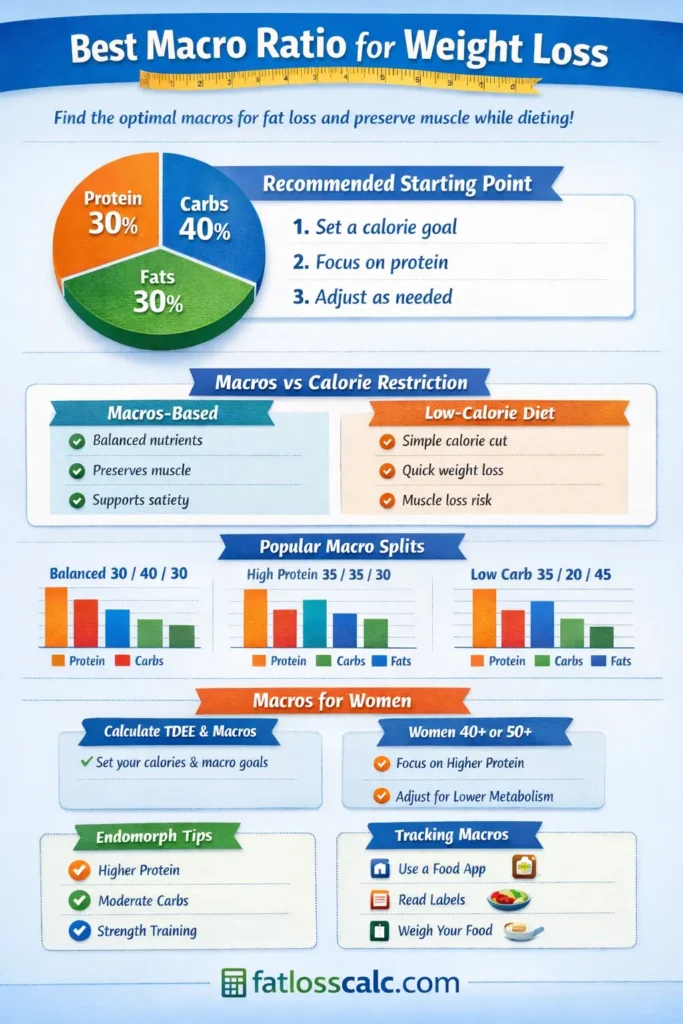
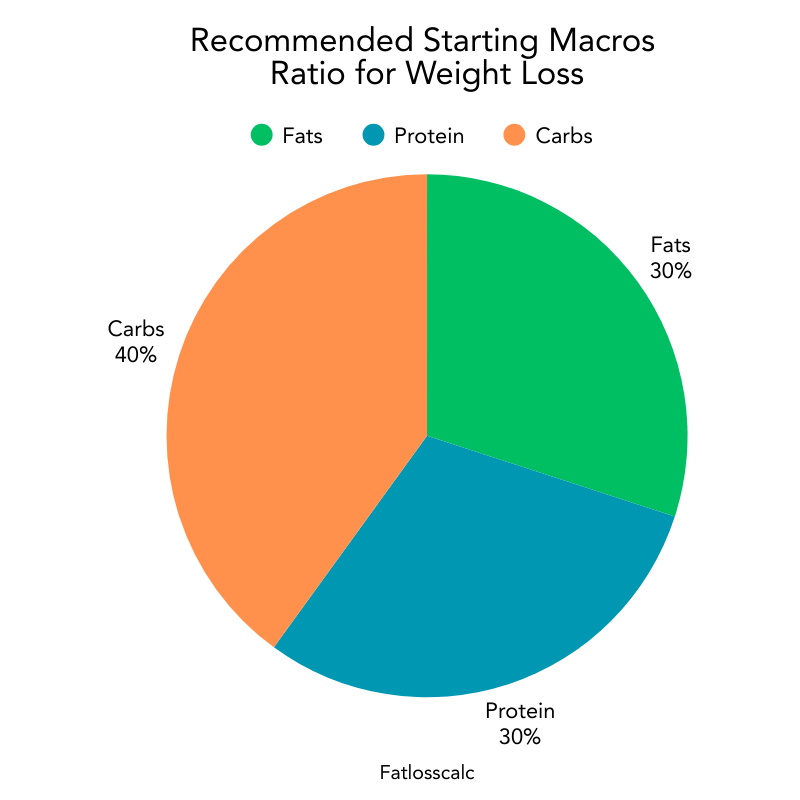
Best macro ratio for weight loss: For most people, a starting macro split of 30% protein, 40% carbohydrates, and 30% fat supports fat loss by preserving muscle, controlling hunger, and maintaining energy — when paired with a calorie deficit. This ratio is not permanent and should be adjusted every 2–4 weeks based on appetite, training performance, and progress.
Are Macros or Calories More Important for Weight Loss?
Calories determine whether weight loss happens. Macros determine how sustainable that weight loss is. A calorie deficit drives fat loss, while adequate protein and balanced carbs and fats help preserve muscle, manage hunger, and maintain energy levels.
Do Macros Matter for Weight Loss?
Yes — especially protein. Higher-protein diets consistently show better preservation of lean mass and greater fat loss in short- to mid-term trials, and they tend to reduce hunger and improve satiety — making a calorie deficit easier to stick to.
That said, long-term superiority of one macro ratio over another is less certain, so personalization matters. Aim for enough protein first, then set a calorie target and choose carbs and fats to fit your lifestyle.
Macros vs Low Calorie (calorie-restricted) Diets
Below is a side-by-side comparison to help you see pros/cons.
| Feature | Macros-based approach | Low Calorie Diets |
| Primary focus | Balance of protein/carb/fat to support satiety and performance | Total calorie intake (deficit) |
| Strengths | Preserves lean mass (if protein adequate); improves fullness; better performance in training. | Simpler conceptually (eat less), proven that a deficit leads to weight loss. |
| Weaknesses | Requires tracking to some extent; can be confusing at first | Can cause muscle loss if protein is low; hunger and adherence issues. |
| Best for | People who exercise, want to keep muscle, want flexible food choices | Those who want very simple rules or short-term rapid results (but risk muscle loss) |
| Practical tip | Set calories, prioritize protein (25–35% of calories), then adjust carbs/fat | Make sure protein is adequate to spare muscle; avoid very low-protein low-calorie plans. |
Common Mistakes People Make with Macros for Weight Loss
1. Changing macros every week: Your body needs time to respond. Adjusting too fast makes it impossible to know what’s working.
2. Going very high-protein without watching calories: Protein helps satiety, but calories still matter. It’s easy to overeat when protein shakes and bars stack up.
3. Dropping carbs too low while training hard: Low energy, poor workouts, and stalled fat loss often follow.
4. Ignoring strength loss: If strength drops steadily, you’re likely under-eating protein, calories, or both.
5. Treating calculators as prescriptions: Calculators are estimates. Your feedback matters more than the number.
What Is the Best Macro Ratio to Lose Weight? (Carbs, Protein, Fats)
There is no universal “best” macro ratio — and anyone claiming otherwise is oversimplifying. What works best is a protein-first approach within a calorie deficit, using carbs and fats as adjustable tools based on hunger, training, and lifestyle.
For most people, starting with a moderate, balanced split and adjusting slowly beats aggressive or extreme ratios.
Recommended ranges (start here and adjust):
Practical example splits:
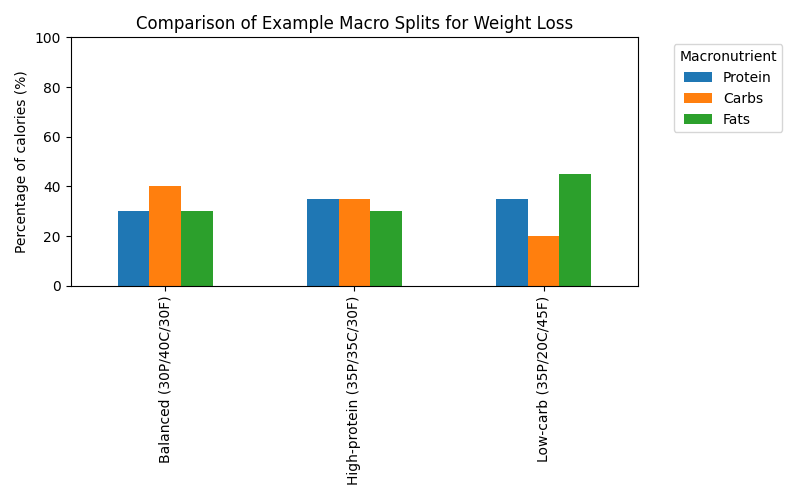
- Balanced starter: 30% protein / 40% carbs / 30% fats — great for most people.
- Higher-protein: 35% protein / 35% carbs / 30% fats — for those who want more muscle preservation and appetite control.
- Lower-carb option: 35% protein / 20% carbs / 45% fats — for people who feel better on fewer carbs.
Why these ranges? Protein requires more energy to digest (higher thermic effect) and supports lean mass; carbs and fats are flexible to support energy and hormones. These ranges also sit within or near standard recommended intakes while allowing a higher protein focus for fat loss.
Verdict: A moderate, protein-forward macro approach works best for most people when calories are controlled and adjustments are made gradually.
Important Tradeoffs to Understand
There is no “free” macro strategy — every approach trades simplicity, flexibility, or performance for control.
Is the 40/40/20 macro diet good for weight loss?
40/40/20 (Protein/Carbs/Fat) is a very protein-forward split and can work — especially if you are active and want strong hunger control.
However, 40% protein equals 40% of calories from protein, which for many diets falls above the Acceptable Macronutrient Distribution Range (AMDR) protein upper guidance (commonly cited as up to ~35% for general populations).
If you choose 40% protein, make sure total calories and protein grams are appropriate for your body weight, and monitor kidney function if you have underlying conditions.
A slightly more conservative 35/35/30 split gives most of the benefits without exceeding commonly used protein ranges.
Complete List of Macros in the Diet
When we talk about macros, we mean the three energy-providing macronutrients:
- Protein — builds and repairs tissue; 4 kcal/g.
- Carbohydrates — primary fuel for brain and high-intensity work; 4 kcal/g.
- Fats — hormone production, energy, and nutrient absorption; 9 kcal/g.
- Dietary fiber — Crucially,dietary fiber is indigestible and doesn’t contribute net calories, but it’s essential for gut health, blood sugar control, and satiety.
Female Macros for Weight Loss
Women often benefit from slightly different approaches because of differences in body composition, hormonal cycles, and average energy needs. Key tips:
- Calculate your total daily energy expenditure to set a calorie target; women tend to have lower TDEE than men.
- Aim for adequate protein — roughly 1.2–1.6 g/kg of bodyweight is often recommended for active women and those preserving muscle while losing fat. You can calculate macros from your calorie goal using our macro calculator.
Suggested starting split for many women: 30% protein / 40% carbs / 30% fats, then personalize based on hunger, energy, and exercise.
Endomorph Macros for Weight Loss
“Endomorph” is a body-type term often used to describe people who gain fat more easily and may have a slower metabolism. Rather than strict typing, focus on physiology and behavior:
- Start with higher protein (30–35%+) to control appetite.
- Consider moderate-carb (30–40%) and slightly higher healthy fats (25–35%) if you tolerate fats well.
- Emphasize resistance training and progressive overload to build lean mass, which raises metabolic rate over time. Low-carb styles can work for some endomorph-type people, but the key is adherence.
How To Find the Macros in Food (Step-By-Step)
- Use nutrition labels: read grams of protein, carbs, and fat per serving; multiply by servings consumed.
- Use a food database or app (MyFitnessPal, Cronometer, FatLossCalc macro calculator) to get accurate macro counts.
- Weigh your food with a kitchen scale for best accuracy.
- Convert grams to calories (protein 4 kcal/g, carb 4 kcal/g, fat 9 kcal/g) to compare against your daily calorie goal.
- Track for 1–2 weeks to learn your patterns, then set a sustainable macro split and adjust as needed.
Also Read: Counting Macros with Alcohol
How to Implement This Plan (7-day Practical Start)
- Calculate TDEE → set a 10–20% calorie deficit.
- Choose a macro split (start 30/40/30).
- Use macro calculator to convert % to grams.
- Track intake for 7–14 days; monitor weight, measurements, energy, and workouts.
- If you’re losing too slowly or losing strength, increase protein or slightly reduce deficit. If hunger is an issue, shift carbs/fats for satiety.
- Reassess every 2–4 weeks.
Key Takeaways
Conclusion
If you want results that stick, don’t obsess over a single “perfect” ratio. Focus on a calorie deficit, prioritize protein to protect muscle and reduce hunger, and pick a macro split (start 30P/40C/30F) that you can live with. Track, adjust every 2–4 weeks, and use the calculators and charts to simplify the math. You’ve got this — build habits, not extremes, and the scale and mirror will follow.
Frequently Asked Questions
View Sources
- Leidy HJ et al., American Journal of Clinical Nutrition — Role of protein in weight loss and maintenance.
- Wycherley TP et al., Obesity Reviews — Meta-analysis of high-protein diets and body fat loss.
- Institute of Medicine — Acceptable Macronutrient Distribution Ranges (AMDR).
- NCBI Bookshelf — Macronutrient intake, variability, and individualization.