If you’re trying to lose fat, you’ve likely encountered two dominant approaches: body recomposition vs cutting. Both promise transformation, but through fundamentally different pathways. As a nutrition coach who has helped hundreds of clients transform their bodies, I’m here to guide you through these approaches and help you determine which is right for YOUR body and goals.
The fitness world is filled with confusion and contradictory advice. Some swear by aggressive “cutting” phases, while others advocate for the more balanced approach of “recomp.” But what really separates these approaches, and more importantly—which will give you the sustainable, lasting results you’re looking for?
In this comprehensive guide, we’ll dive deep into both methods, arming you with the knowledge to make an informed decision and finally achieve the transformation you’ve been working toward.
Also Read: How to Quit Soda — 5 Best Ways that Work
What is Body Recomposition?
Body recomposition (recomp) refers to the process of simultaneously losing body fat while gaining muscle mass. Unlike traditional weight loss that focuses solely on the number on the scale, recomp focuses on changing your body’s composition—the ratio of fat to muscle that determines your actual physique.
Think of it this way: if you were to only track scale weight, you might miss the incredible progress happening beneath the surface. With body recomposition, the scale might not move dramatically, but your body transforms in profound ways:
- Clothes fit better even at the same weight
- Muscle definition emerges where there was none before
- Metabolism improves as you build metabolically active tissue
- Strength increases alongside visual changes
The scale can be deceptive—it doesn’t distinguish between fat loss and muscle gain. Since muscle is denser than fat, it takes up less space. This means you can appear smaller and more toned without dramatic changes on the scale. I’ve had clients who dropped three clothing sizes while losing only five pounds on the scale—that’s the power of recomposition!
How does body recomposition work?
At its core, recomposition is the result of two processes happening simultaneously: fat loss (via a calorie deficit or maintenance with better body-fat partitioning) and muscle gain (stimulated by resistance training, adequate protein, and progressive overload). The essential elements are:
- Consistent resistance training that prioritizes progressive overload (strength gains drive muscle protein synthesis).
- Sufficient dietary protein to support muscle repair and growth.
Appropriate calorie strategy: slight deficit, maintenance, or cycling calories around workouts — depending on your starting point. - Patience and realistic expectations: changes are usually slower than single-focus strategies (like a strict cut or a dedicated bulk).
Scientific reviews highlight these mechanisms and confirm recomposition is feasible — especially for beginners, people returning to training, and individuals carrying higher body fat.
Is body recomposition the same as cutting?
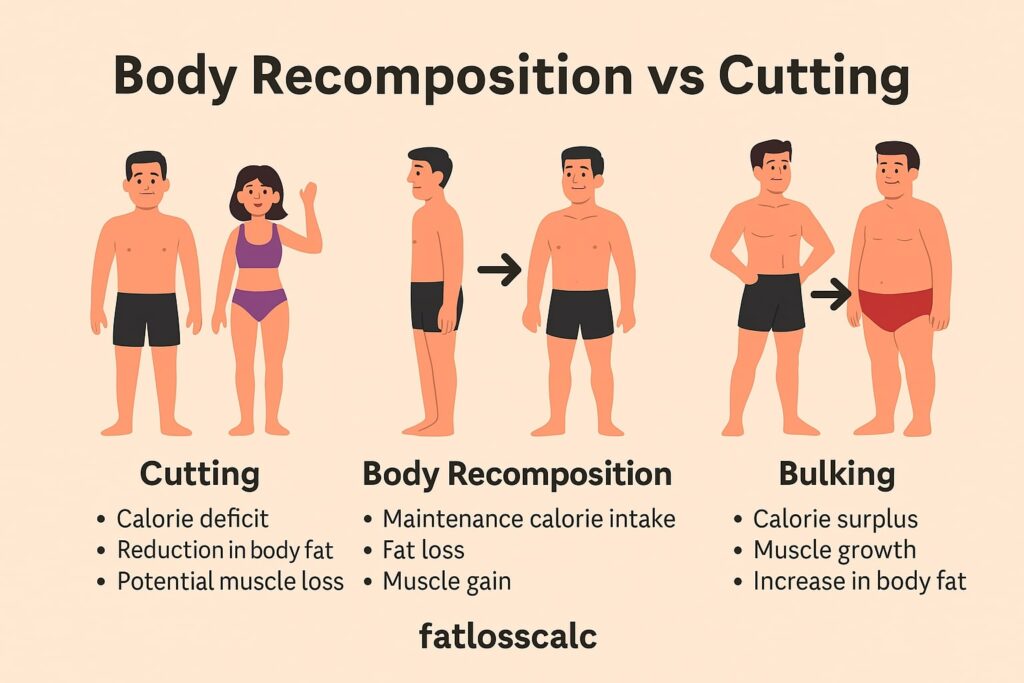
No — body recomposition and cutting are related but not the same.
- Cutting: A cut is a planned, sustained calorie deficit intended to lose body fat and reduce scale weight. Cutting is generally faster at fat loss and often used by people who want quick visible change, competition prep, or to reach a lower body-fat baseline before a muscle-building phase.
- Recomposition: A recomp aims for fat loss while preserving or building muscle simultaneously. It’s typically a slower process and depends heavily on resistance training and protein intake. Recomp is often recommended for beginners, people with higher body fat, or those who value steady, sustainable changes without long periods of dieting.
Table: Body Recomposition vs. Cutting at a Glance
| Factor | Body Recomposition | Cutting |
| Primary Goal | Lose fat while building muscle | Maximize fat loss while preserving muscle |
| Calorie Intake | Small deficit or at maintenance | Significant deficit (500+ calories) |
| Protein Intake | High (0.8-1.2g per lb of body weight) | High (similar to recomp) |
| Training Focus | Strength training with progressive overload | Mixed: strength maintenance + increased cardio |
| Timeframe | Long-term lifestyle | Short-term phase (weeks to months) |
| Scale Weight | May stay the same or change slowly | Decreases steadily |
| Sustainability | High (can be maintained indefinitely) | Low (not meant for long-term use) |
| Best For | Most people, especially beginners to intermediate trainees | Experienced lifters, pre-competition |
Web resources and coaching data show cutting is usually faster for large fat losses, while recomp is more nuanced and personalized.
How to change your body composition without cutting
You can change body composition without a prolonged calorie cut by using one or more of these strategies:
- Eat more calories and prioritize protein — this improves “body-fat partitioning” so more calories are directed to muscle repair and less to fat storage. Use body recomposition calculator to find out your daily requirement of calories and macros.
- Use calorie cycling: Slightly increase calories on workout days and reduce them on rest days (this supports training performance while keeping average intake near maintenance).
- High-protein intake with resistance training — protein protects muscle during any calorie shortfall and supports gains when training stimulus is strong.
- Focus on progressive overload, training quality, and recovery (sleep, stress management).
These tactics can produce noticeable recomposition — particularly for beginners and those returning from a training layoff. The scientific literature and coaching case-series highlight the success of these methods.
How long does it take?
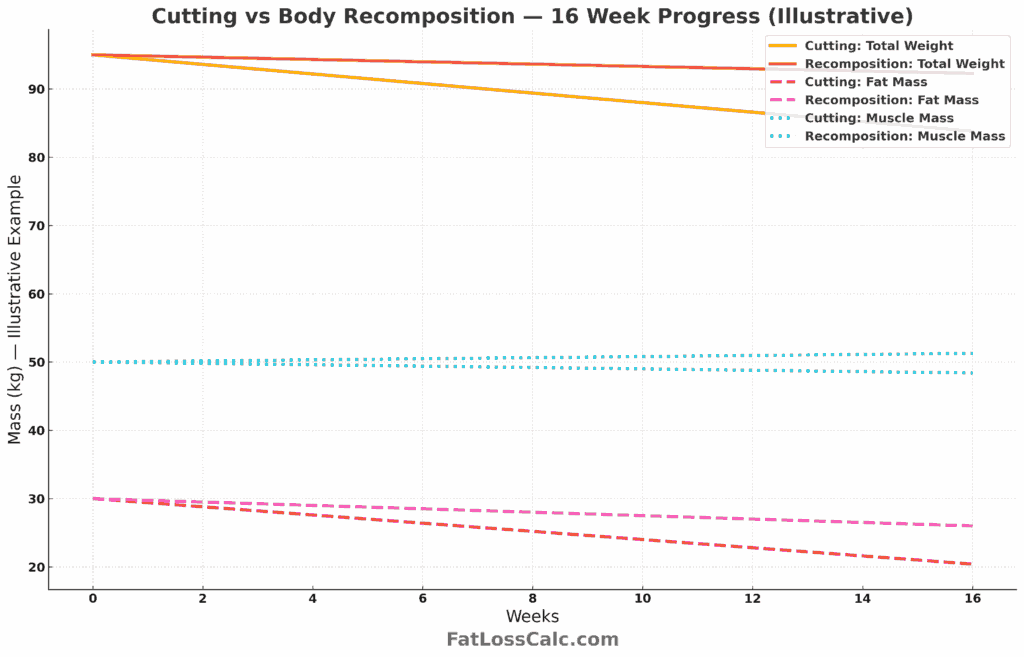
There is no single answer — but realistic timelines help set expectations:
- Beginners or people returning to training: Noticeable changes in 8–16 weeks (sometimes faster), with measurable improvements in strength and body shape.
- Intermediate lifters: Slower changes — expect months of steady progress; recomposition becomes tougher and slower as you gain training experience.
- Advanced athletes: Very slow; single-focus phases (cut or bulk) are usually more efficient.
For fat loss speed, experts recommend modest, sustainable rates (roughly 0.5–1% of body weight per week for leaner individuals, a bit higher if you carry more fat).
For muscle gain, realistic rates vary by training status and sex; expect a few hundred grams to a kilogram of lean mass per month early on, then tapering. Precision Nutrition and coaching data provide practical rate ranges you can plan around.
Is cutting a better option for you?
Achieving results by following cutting diet is easier than body recomposition. Use our macros calculator to get customized settings for macros and calories.
Choose cutting if:
– You’re already lean and want to get noticeably leaner quickly.
– You have a specific short-term deadline (event, photo shoot, competition).
– You prefer to focus on one goal at a time and don’t want to risk slow progress in both areas.
Choose recomposition if:
– You’re a beginner, returning lifter, or have higher body fat (recomp tends to work well here).
– You prefer steadier changes and want to avoid long dieting phases.
– You value strength and performance during your fat-loss journey.
Both strategies can be effective — the best choice depends on your body, preferences, and timeline.
How many calories should I cut for a body recomposition?
For recomposition, aggressive cutting is counterproductive.
– A small deficit (≈10–15% below maintenance) OR eat at maintenance and prioritize protein and resistance training.
– If you cut, aim for slow, sustainable fat loss (roughly 0.25–0.5% of body weight per week for leaner individuals; up to 1% per week if you’ve got higher starting body fat and want faster change). Use Recomp Calculator to determine your daily calorie intake
The reason: a severe deficit starves muscle-building processes and undermines training quality. Scientific coaching guidance recommends conservative deficits for better muscle retention and training performance.
How much protein should I consume for recomp?
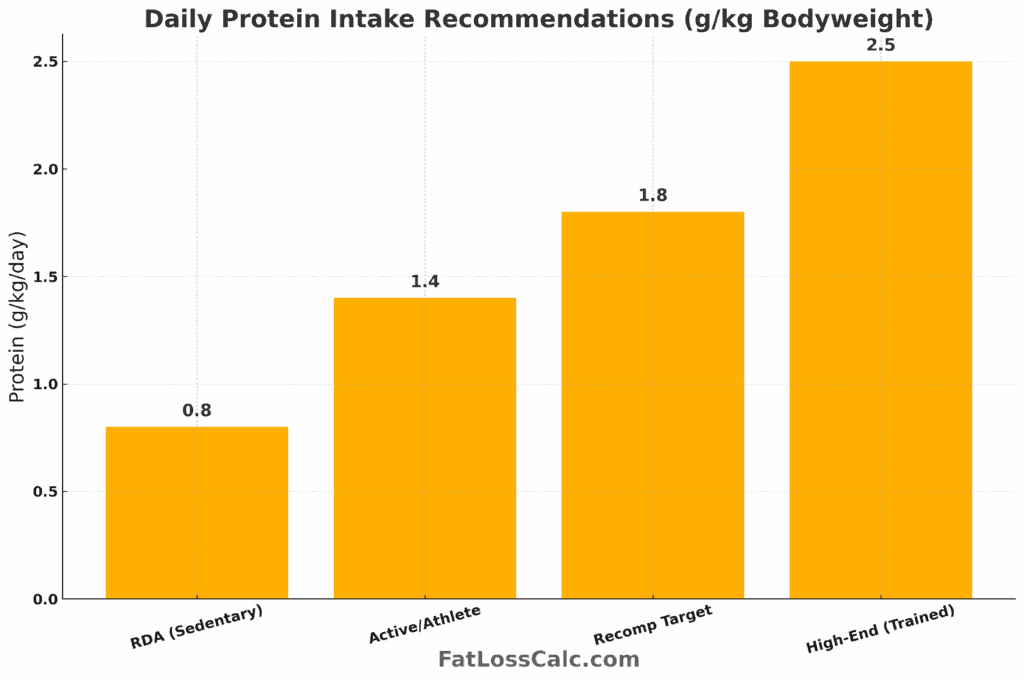
Protein is a cornerstone. Below are the recommended targets depend on body weight.
A common evidence-based starting point is 1.6–2.2 grams per kg bodyweight per day (about 0.7–1.0 g per lb). This range supports muscle protein synthesis, helps preserve lean mass in a deficit, and supports gains during recomp. Some trained athletes may benefit from higher intakes (up to ~2.5–3.0 g/kg) in specific situations, but benefits plateau for most people. International Society of Sports Nutrition position stands and systematic evidence syntheses back these ranges.
Distribute protein across 3–5 meals to support repeated muscle protein synthesis opportunities.
Aim for ~20–40 g high protein per meal (adjust for bodyweight and age — older adults may need more per meal). Use whole-food sources first (eggs, dairy, lean meats, legumes), add whey or higher-protein supplements if needed.
What are the biggest mistakes people make when trying to achieve body recomposition?
1. Expecting fast results: Recomposition is often slower than a straight cut or bulk. Unrealistic expectations lead to premature quitting.
2. Skimping on protein: Low protein makes muscle retention or growth far harder when trying to lose fat.
3. Not prioritizing resistance training: Cardio-only approaches accelerate fat loss but increase muscle loss risk unless combined with resistance work.
4. Too large a calorie deficit: Aggressive cuts kill training performance and muscle-building signals.
5. Poor sleep and recovery: Training without recovery undermines muscle repair and adaptation.
6. Measuring only the scale: The scale can disguise positive changes; use measurements, pictures, and strength metrics. Research and coaching data highlight these recurring errors.
Is it possible?
Yes. Multiple controlled trials, reviews, and coaching datasets show recomposition can and does happen — especially for beginners, those with higher body fat, and people returning to training. However, the likelihood and magnitude of simultaneous muscle gain and fat loss shrink as you become more advanced. A 2024 editorial and several intervention studies summarize this realistically: it’s possible but context-dependent.
Should I do cardio?
Short answer: Yes — but prioritize resistance training first.
Cardio helps with calorie expenditure, cardiovascular health, and recovery. For recomposition:
– Keep cardio moderate to avoid interfering with strength performance (avoid excessive steady-state cardio that impairs recovery).
– Use a combination of moderate-intensity steady-state (MISS) and short high-intensity interval sessions (HIIT) as desired, but never at the expense of progressive overload in the weight room.
– Walk more: non-exercise activity thermogenesis (NEAT) is a powerful and low-stress way to increase calorie burn without affecting recovery.
Also Read: Carbs Are Not Bad — Why Carbohydrates Can Help You Lose Weight
Body Recomposition — A Practical 8-Week Starter Plan
Week 0: Test & prepare
– Take photos, body measurements, and strength baseline (e.g., 3–5 rep max for a few core lifts).
– Estimate maintenance calories with a TDEE calculator and pick a plan: slight deficit (–10%) or maintenance with high protein.
– Log food for 3–7 days to check reality vs. estimated intake.
Weeks 1–8: Training & nutrition
– Strength: 3–5 sessions/week focusing on compound lifts and progressive overload.
– Protein: aim for 1.6–2.2 g/kg/day.
– Calories: maintenance or –10% deficit; adjust after 3–4 weeks based on progress.
– Cardio: 1–3 low-to-moderate sessions/week; daily walking encouraged.
Progress check at week 4 and 8: measure, photograph, track strength. Adjust calories by small amounts (100–200 kcal) as needed.
View Sources
– Sumithran, P., Prendergast, L. A., Delbridge, E., Purcell, K., Shulkes, A., Kriketos, A., & Proietto, J. (2011). Long-term persistence of hormonal adaptations to weight loss. New England Journal of Medicine, 365(17), 1597-1604.
– ISSN Protein Position Stand. Link.
– Precision Nutrition rate guidance and coaching insights: Link.