The Ideal Body Weight Calculator helps you estimate a healthy weight range based on height, gender, and frame size. Use it as a practical reference—not a strict target—and understand what your number actually means.
Gender
Frame Size
Height
Most people don’t start searching for an ideal body weight because they’re curious about formulas. They do it after stepping on the scale, seeing a number that feels wrong, and wondering whether they should trust it. I’ve seen many people chase a specific “ideal” weight only to feel frustrated when reaching it doesn’t improve energy, strength, or confidence.
That’s where ideal body weight calculators can quietly cause problems. Used correctly, they offer context. Used obsessively, they can turn into a rigid target that ignores muscle mass, age, health history, and how someone actually functions day to day.
An Ideal Body Weight (IBW) Calculator isn’t meant to tell you what you must weigh. It’s a reference point—one piece of information among many. Understanding what it measures, what it ignores, and when it becomes misleading is more important than the number it produces.
This article breaks down how an Ideal Body Weight Calculator works, where the formulas come from, and how to interpret your results without turning a useful health tool into unnecessary pressure.
Related Fat Loss Calculators
These calculators help estimate calorie needs, macronutrients, and body composition when planning sustainable fat loss. Many people begin by estimating daily calorie expenditure using the TDEE Calculator, then determine a realistic calorie reduction with the Calorie Deficit Calculator. Tools like the Macro Calculator and Body Recomposition Calculator help structure protein, carbohydrate, and fat intake, while the Body Fat Percentage Calculator, BMI Calculator, and Ideal Body Weight Calculator provide additional context for body composition and healthy weight ranges.
- TDEE Calculator
- Calorie Deficit Calculator
- Macro Calculator
- Body Recomposition Calculator
- Body Fat Percentage Calculator
- BMI Calculator
- Ideal Body Weight Calculator
Ideal Body Weight Calculator: Quick Summary
An Ideal Body Weight Calculator estimates a healthy weight range based on height and gender using established medical formulas like Devine or Peterson. It does not measure body fat or muscle mass. The result should be used as a reference point alongside waist circumference, strength levels, and clinical health markers.
It should not replace individualized medical evaluation, especially for individuals with chronic conditions, recent weight changes, or a history of disordered eating. Medical professionals often use ideal body weight formulas for medication dosing, but broader health assessment always requires multiple markers.
Common searches related to the Ideal Body Weight Calculator include frame size adjustments, percentage of ideal body weight, and formula comparisons such as the Hamwi equation. Use the Ideal Body Weight Calculator above to estimate your range, then review the interpretation guide to understand what your number actually means.
What Is Ideal Body Weight?
Ideal body weight is an estimated healthy weight range based on height and sex, calculated using standardized medical formulas such as Devine, Robinson, or Peterson. It reflects population averages—not individual body composition.
It is not a personal health diagnosis, and it does not define fitness, attractiveness, or metabolic health.
How Much Should I Weigh?
There is no single number that every person “should” weigh. An Ideal Body Weight Calculator provides a statistical reference based on height and sex, but true health depends on body composition, metabolic markers, strength, and lifestyle habits.
For most adults, a reasonable starting point is:
- A weight within 90–110% of calculated ideal body weight
- A waist circumference within healthy clinical ranges
- Stable energy levels and normal blood markers
The goal is not perfection. It is metabolic stability and functional strength.
In clinical settings, providers may also compare weight trends over time rather than relying on a single measurement.
What Is Percentage of Ideal Body Weight?
Percentage of ideal body weight compares your current weight to your calculated ideal body weight. It is calculated using the formula:
(Current Weight ÷ Ideal Body Weight) × 100
Clinically, 90–110% of ideal body weight is often considered within a general reference range, though interpretation depends on context, muscle mass, and overall health markers.
This calculation is sometimes used in hospital and nutrition settings to assess underweight or overweight status.
Ideal body weight can be useful in medical settings—such as medication dosing or initial nutritional assessments—but it becomes less reliable for individuals with higher muscle mass, age-related muscle loss, or unique body compositions.
Ideal body weight is also sometimes referenced in sports that classify competitors by body weight, although performance and body composition are usually more relevant than the formula alone.
Unlike BMI, an Ideal Body Weight Calculator attempts to narrow the range using height and gender. However, they still rely on averages. That means two people with the same height can have very different healthy weights depending on strength, bone density, and lifestyle. The most responsible way to view IBW is as a reference range, not a goal weight you need to reach.
If you’re unsure how BMI compares to IBW, you can check your current weight category using our BMI Calculator.
Healthy BMI Range and Ideal Body Weight
The World Health Organization defines a healthy BMI range as 18.5–24.9 for adults. While BMI and ideal body weight are calculated differently, you can use our BMI Calculator to compare results and understand how both measurements relate to your overall weight category.
To understand how many calories your body needs to maintain your current weight, you can estimate your maintenance intake using our TDEE Calculator.
However, neither measurement accounts for muscle mass or fat distribution. That’s why an Ideal Body Weight Calculator should be interpreted alongside waist circumference, body fat percentage, and strength markers.
For a more complete body composition assessment, you can estimate your fat mass using our Body Fat Percentage Calculator to evaluate body composition alongside your Ideal Body Weight Calculator results.
Does Age Affect Ideal Body Weight?
Age does not dramatically change ideal body weight after full growth is reached in early adulthood. However, body composition shifts over time. Lean muscle mass tends to decline gradually after age 30, while body fat percentage may increase even if scale weight remains stable.
Most ideal body weight formulas do not directly adjust for age. That’s why interpretation should include strength levels, mobility, metabolic markers, and waist circumference — not just the calculated number.
Formulas for Finding the Right Weight
Several medically accepted formulas estimate IBW. Here are the most widely used:
1. Devine Formula (1974)
- Men: 50 kg + 2.3 kg per inch over 5 feet
- Women: 45.5 kg + 2.3 kg per inch over 5 feet
- Advantages: Simple, gender-specific.
- Disadvantages: Doesn’t account for muscle mass or body composition.
2. Peterson Formula (2016)
- Equation: 22 × (Height in meters)²
- Advantages: Based on BMI 22 (midpoint of the healthy range).
- Disadvantages: Less personalized for gender or frame size.
3. Robinson Formula (1983)
- Men: 52 kg + 1.9 kg per inch over 5 feet
- Women: 49 kg + 1.7 kg per inch over 5 feet
- Advantages: Updated version of Devine formula.
- Disadvantages: Still overlooks body frame differences.
4. Hamwi Equation for Ideal Body Weight (1964)
The Hamwi equation for ideal body weight is one of the earliest clinical methods used to estimate healthy weight ranges.
- Men: 106 lbs + 6 lbs per inch over 5 feet
- Women: 100 lbs + 5 lbs per inch over 5 feet
- Advantages: Easy imperial-unit calculation.
- Disadvantages: Outdated for modern body types.
5. Miller Formula (1983)
• Men: 56.2 kg + 1.41 kg per inch over 5 feet
• Women: 53.1 kg + 1.36 kg per inch over 5 feet
• Advantages: Alternative coefficient variation.
• Disadvantages: Still limited to height and sex only.
Advantages and Disadvantages of Each Formula
| Formula | Pros | Cons |
|---|---|---|
| Devine | Gender-specific, simple math | Ignores muscle mass and frame size |
| Peterson | Uses BMI 22 standard | No gender differentiation |
| Robinson | Updated coefficients | Still excludes frame size |
| Hamwi | Easy imperial conversion | Less accurate for taller individuals |
If you’re wondering which formula matters most, the honest answer is: none of them are perfect. These equations were designed for convenience, not precision.
Clinicians still use them because they provide a fast baseline when more detailed body composition data isn’t available. The tradeoff is accuracy. The simpler the formula, the more it ignores muscle mass, fat distribution, and age-related changes.
For most people, consistency matters more than choosing the “best” equation. Using one method as a reference—rather than jumping between formulas—reduces confusion and unrealistic expectations.
Limitations of an Ideal Body Weight Calculator
All ideal body weight formulas rely primarily on height and sex. They do not account for muscle mass, fat distribution, ethnicity, activity level, or existing medical conditions.
This is why two people with identical heights may have very different healthy weight ranges.
Because of this, results should be viewed as general guidelines rather than precise prescriptions. An Ideal Body Weight Calculator works best when combined with body composition metrics and clinical evaluation.
Common Mistakes When Using an Ideal Body Weight Calculator
Most problems don’t come from the math. They come from how people interpret the number.
Here are the most common mistakes I see:
1. Treating IBW as an aesthetic goal
An Ideal Body Weight Calculator estimates statistical health ranges. It does not define what you “should” look like. Many people try to diet aggressively to hit the number, even when their labs, strength, and energy are normal.
2. Crash dieting to reach the result
Rapid calorie cuts may lower scale weight temporarily, but they often reduce muscle mass. That can actually worsen metabolic health while technically moving you closer to your calculated IBW.
3. Comparing your number to athletes or influencers
Muscular individuals often weigh more than their calculated ideal body weight. That does not mean they are unhealthy.
4. Formula shopping
Switching between Devine, Robinson, Peterson, and Hamwi just to find a lower number creates confusion. Pick one method for consistency.
5. Ignoring waist circumference and strength markers
If waist size, blood work, blood pressure, and strength levels are improving, that matters more than chasing a specific IBW result.
The Ideal Body Weight Calculator is a reference tool. It becomes harmful only when used as a rigid target instead of a flexible guideline.
How to Estimate Frame Size for an Ideal Body Weight Calculator?
Many users specifically look for an ideal body weight calculator with frame size adjustment because skeletal structure can meaningfully influence healthy weight ranges.
Frame size impacts IBW calculations by ±10%. Use these methods to determine yours:
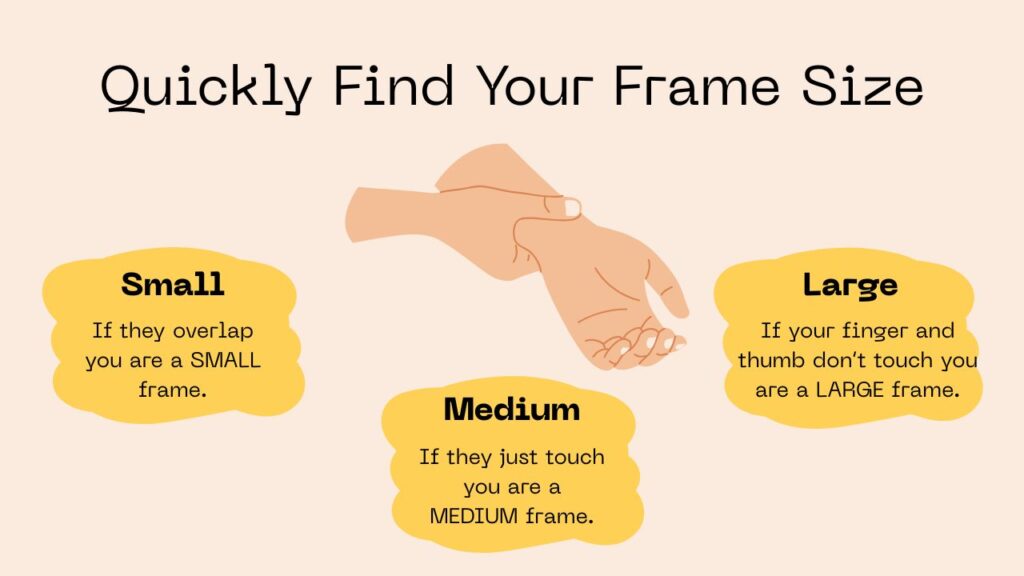
1. Wrist Circumference Method:
Wrap your thumb and middle finger around your wrist.
- Small Frame: Fingers overlap.
- Medium Frame: Fingers touch.
- Large Frame: Fingers don’t meet.
2. Elbow Breadth Measurement:
- Use a caliper to measure elbow width.
- Compare results to standardized charts.
How to Reach Your Ideal Body Weight?
If your current weight falls outside your estimated IBW range, that doesn’t automatically mean something needs to change. Context matters.
When weight adjustment is appropriate, gradual changes are safer and more sustainable than aggressive targets.
Practical guidance:
If your weight is significantly above or below your calculated range, adjust in this order:
1. Protein intake first: Aim for adequate daily protein to preserve or build lean mass. To estimate your daily protein needs during weight loss, you can use our High Protein Weight Loss Calculator.
2. Sleep quality: Chronic sleep restriction disrupts hunger hormones and slows progress.
3. Daily movement: Increase non-exercise activity (walking, steps, general movement) before slashing calories.
4. Calorie adjustments last: If needed, adjust intake modestly (5–10%) and reassess after 4–6 weeks.
If you want to structure daily nutrition around your weight goals, our Macro Calculator can estimate appropriate protein, carbohydrate, and fat targets.
For example:
If someone is 15–20 lbs above their Ideal Body Weight Calculator estimate but has normal labs, good strength, and healthy blood pressure, aggressive weight loss is rarely necessary. Improving body composition gradually is usually smarter than chasing a specific number.
Reassess progress every 4–6 weeks. Daily scale changes are noise. Trends matter more.
Which Formula Does This Calculator Use?
This calculator uses the Devine formula with frame-size adjustments to offer a general estimate. The result should be interpreted alongside other indicators such as waist circumference, body fat percentage, strength levels, and overall health markers.
Unlike a basic ideal weight calculator, this Ideal Body Weight Calculator includes frame size adjustments to provide a more individualized estimate.
Think of the output as a range for discussion, not a finish line. Different formulas may produce slightly different results, which is why consistency in method matters more than chasing the lowest number. Sharing these results with a qualified healthcare provider helps place them in proper medical context.
For example:
- A 5’7” (170 cm) woman with a medium frame receives:
- Devine IBW: 135–145 lbs (61–66 kg)
- BMI Range: 118–158 lbs (53.5–72 kg)
This dual approach provides both a personalized target and a broader healthy range for context.
If your goal is improving body composition rather than reaching a specific scale weight, you can estimate calorie and macro targets using our Body Recomposition Calculator.
Related Nutrition Calculators
Nutrition planning works best when calorie intake, macronutrient targets, and body composition metrics are considered together. The TDEE Calculator estimates daily calorie expenditure, while the Macro Calculator, High Protein Weight Loss Calculator, and Body Recomposition Calculator help structure protein, carbohydrate, and fat intake using different dietary strategies.
Popular Fat Loss Calculators
- TDEE Calculator
- Calorie Deficit Calculator
- Macro Calculator
- Body Recomposition Calculator
- Body Fat Percentage Calculator
- Ideal Body Weight Calculator
- Intermittent Fasting Calculator
Frequently Asked Questions
Conclusion
An Ideal Body Weight Calculator can be helpful—but only when it’s used with perspective. It offers structure, not certainty.
Health isn’t defined by landing on a specific number. It’s shaped by sustainable habits, functional strength, metabolic health, and how your body performs over time. Treat IBW as a reference point, stay flexible, and prioritize long-term well-being over precision.

View Sources
- Devine BJ. Gentamicin therapy. Drug Intelligence & Clinical Pharmacy. 1974.
- Peterson CM et al. Using BMI-based equations to estimate ideal body weight. Journal of the American College of Clinical Pharmacy. 2016.
- Hamwi GJ. Therapy: Changing dietary concepts. Diabetes Mellitus: Diagnosis and Treatment. 1964.
- National Institutes of Health (NIH). Healthy Weight Guidelines. Link.
- Centers for Disease Control and Prevention (CDC). About Adult BMI. Link.