If you’re looking for an efficient way to burn fat, improve cardio fitness, and boost your metabolic health — all in a relatively short amount of time — High-Intensity Interval Training (HIIT) may be your best friend. Instead of grinding away on a treadmill for 45–60 minutes, HIIT asks: can you push hard for short bursts, rest (or go light) briefly, then repeat? The answer is yes — and the results can be compelling when done smartly.
As a coach, I often tell clients: HIIT is not a magic pill, but it can help you get more work done in less time, preserve lean muscle, and ramp up your metabolism. Think of it as quality over endless quantity. That said, it’s not for everyone (we’ll get to the cautions, too). Let’s dive in.
What Are Examples of High Intensity Interval Training?
HIIT is a broad umbrella. What qualifies can vary by intensity, duration, and rest style. Some examples:
- Sprint intervals: e.g. 30 seconds all-out sprint, 60 seconds walking or jogging recovery.
- Bike HIIT: 20 seconds pedal at max effort, 40 seconds slow spin.
- Circuit HIIT: bodyweight or dumbbell movements (burpees, jump squats, push-ups) with short rest between.
- Tabata style: 20 s maximum effort, 10 s rest, repeat – more on this later.
- “30-20-10” protocol: e.g. 30 seconds low, 20 moderate, 10 high intensity. (Healthline calls this an interesting hybrid).
- The “Norwegian 4×4” model: 4 minutes high intensity, 3 minutes moderate, repeated 4 times.
Because HIIT is flexible, you can tailor it to your modality (running, rowing, bodyweight, cycling) and fitness level.
Also Read: Fatlosscalc Blog
How Long Are the Durations of Intervals?
There’s no one-size-fits-all answer, but here’s a practical breakdown:
- Short bursts: 10–30 seconds of high intensity, followed by rest or active recovery.
- Mid-length: 30–60 seconds high, with 15–60 seconds recovery.
- Longer intervals: up to 2–3 minutes high, with equal or slightly longer rest — but these are less “pure” HIIT and more hybrid with aerobic components.
- Whole session length: many HIIT workouts last between 4 and 30 minutes inclusive of rest and warm-up/cool-down.
A common ratio is 2:1 work-to-rest (e.g. 40 s effort: 20 s rest), or 1:1 (30 s: 30 s). As you get fitter, you can push the work periods longer or shorten rests.
What Are Common HIIT Exercises?
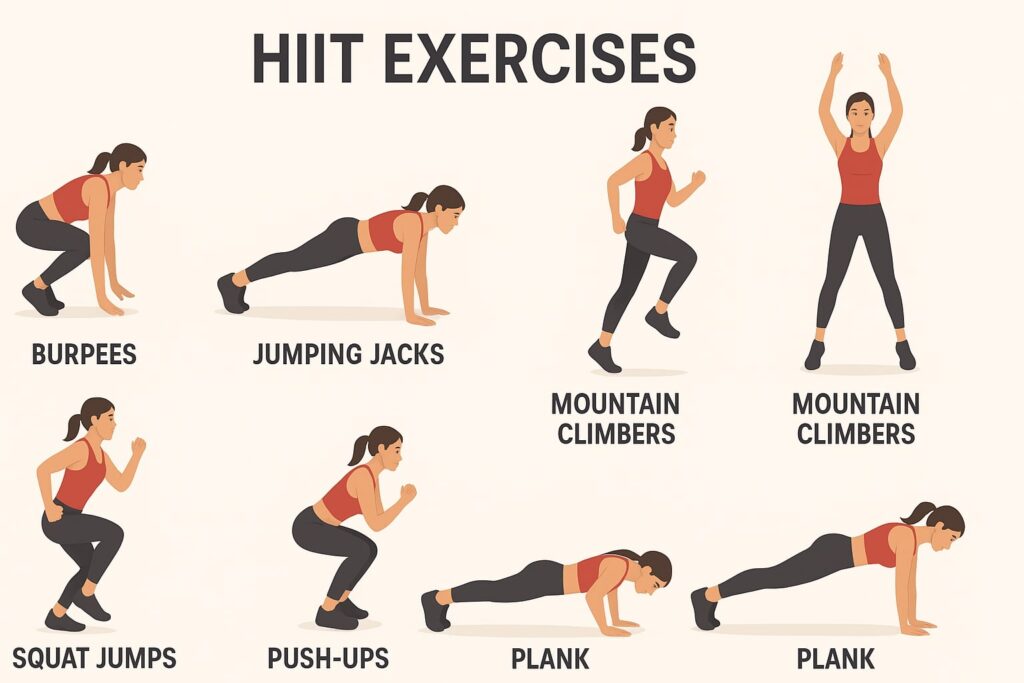
Here are go-to movements that pair well with HIIT:
These are common because they engage multiple muscle groups, elevate heart rate fast, and require minimal equipment.
How Can HIIT Help You Lose Weight?
As a coach, this is one of clients’ first questions. Here’s how HIIT supports fat loss — with caveats.
- High calorie burn in short time:Because you push near your max, you burn more calories per minute than you might in steady-state cardio.
- Afterburn / EPOC effect:HIIT elevates your metabolism post-workout (excess post-exercise oxygen consumption), so your body continues burning more calories while you rest.
- Improved insulin sensitivity & metabolic health: Interval training stimulates better glucose uptake in muscles.
- Muscle preservation: Because HIIT is intense and involves resistance or body weight moves, there’s a better chance to preserve lean mass compared to long, steady-state cardio. That supports a higher resting metabolic rate.
- Time efficiency: Many people abandon long workouts. HIIT gives you more “bang for your time,” making adherence more realistic for busy folks.
Caveat: Weight loss ultimately depends on your calorie balance. HIIT is a tool — pair it with smart nutrition (which might involve macro counting) and rest. Also, overdo HIIT with underfueled calories and you risk injury or burnout.
HIIT and Macro Counting
When you track macros (protein / carbs / fats), HIIT has some implications:
- Higher carbohydrate demand: HIIT relies more on anaerobic glycolysis, so you’ll need sufficient carbs (especially around workouts) to fuel performance and recovery.
- Protein: Adequate protein ensures muscle repair and prevents muscle loss during intense training phases.
- Fat: You still need fat for hormonal health; but since HIIT is energy-demanding, keep your fat intake balanced—not too low.
- Nutrient timing: Pre-HIIT your body benefits from some carbs (e.g., 20–30 g) and post-workout recovery ideally includes protein + carbs to replenish glycogen and repair muscle.
If you already use calculators, you can adjust your macros slightly upward during HIIT phases to support performance, but not so much that you offset the calorie deficit entirely.
HIIT Workouts for Beginners
If you’re new to HIIT, ease in. Here’s a safe progression:
- Warm-up (5–10 min): light cardio, mobility, dynamic stretches
- Start with shorter work periods: e.g. 20 seconds work / 40 seconds rest
- Use low-impact movements at first (marching in place, half-squats, stepping)
- Limit rounds: 3–5 cycles
- Focus on form over speed
- Rest well between sessions; allow recovery days
- Listen to your body — skip HIIT when you feel excessively fatigued
Example beginner plan:
| Round | Work | Rest |
|---|---|---|
| 1 | Jumping jacks – 20 s | 40 s |
| 2 | Bodyweight squats – 20 s | 40 s |
| 3 | Push-up (modified) – 20 s | 40 s |
| 4 | Mountain climbers – 20 s | 40 s |
Repeat once more if feeling fit, then cool down. As you build capacity, you can shift to more demanding protocols.
6-Minute HIIT Workout
Sometimes you’re strapped for time. Here’s a sharp 6-minute HIIT you can squeeze in:
Warm-up: 1 minute brisk march / light movement
Core 4 minutes:
- 30 s burpees / 30 s rest
- 30 s mountain climbers / 30 s rest
- 30 s jump squats / 30 s rest
- 30 s high knees / 30 s rest
Cool-down: 1 minute stretching or walking
You could also do a Tabata (20 s on / 10 s off, 8 rounds = 4 minutes) plus warm-up and cool-down, bringing total to ~6 minutes.
10-Minute HIIT Workout Protocol
Here’s a balanced 10-minute HIIT you can try:
- Warm-up: 1 minute light jog or brisk march
- Main set (8 minutes) — choose 4 exercises, do 40 s work / 20 s rest × 2 rounds:
- Burpees
- Jump lunges
- Push-ups
- Mountain climbers
- Cool-down: 1 minute walking + gentle stretches
Alternatively, use running: 3 min steady, then sprint 1 min / walk 1 min × 2, then 3 min easy.
Because the session is short, you can push hard — but still respect form and stay safe.
The Benefits of HIIT
From a coach’s lens, these are the “big wins” I see in clients who adopt consistent HIIT (with recovery and nutrition):
- Cardiovascular gains / VO₂ max improvement: HIIT often improves aerobic fitness more efficiently than moderate continuous exercise.
- Fat loss / improved body composition: Many report reductions in visceral fat and body-fat percentage (especially when combined with a caloric deficit)
- Time efficiency: Because HIIT is intense and short, it fits into busy schedules more easily.
- Metabolic benefits: Better insulin sensitivity, improved glucose regulation, improved lipid profiles.
- EPOC / afterburn: Enhanced calorie burn for hours post-session.
- Versatility & minimal equipment: You can do HIIT in many modalities (bodyweight, running, bikes, circuits) with little gear.
- Cognitive and mental benefits: Some studies show HIIT supports brain health and cognitive resilience.
- Greater enjoyment / sustainability: Many people find HIIT more engaging than long, steady cardio—and that helps consistency.
The Downsides of HIIT
I always warn clients: HIIT is powerful, but it’s not without risks or limits.
- Injury risk / overuse: If you rush form or increase intensity too quickly, joints, tendons, and muscles can suffer.
- Recovery demands: HIIT is taxing; without adequate rest and sleep, you can overtrain or plateau.
- Not ideal daily: Too much HIIT can lead to burnout or hormonal stress. Use it 2–4 times per week depending on fitness.
- Tough for beginners or with health conditions: If you’re new to exercise, have cardiovascular disease, joint issues, or certain chronic conditions, you need medical clearance.
- Limited volume for endurance development: HIIT is great for bursts and cardio capacity, but long endurance athletes still benefit from some steady-state work.
- Nutrition sensitivity: If your fueling is off, HIIT may lead to fatigue, muscle breakdown, or poorer performance.
So the key is balance — integrate HIIT with recovery, mobility, and moderate training.
Popular Interval Training Workouts
People often refer to branded or named interval systems. Some of the well-known ones are:
- Tabata — 20 s on / 10 s off × 8 = 4 min intense work.
- Little Method (Gibala “Little protocol”) — roughly 60 s high / 75 s easy, repeated 8–12×.
- 4×4 (Norwegian) — 4 minutes high, 3 minutes moderate, repeat 4 rounds.
- 30-20-10 model — as described above.
- Sprint Interval Training (SIT) — pushing closer to all-out sprints with longer recovery periods (sometimes considered a subset or extreme form of HIIT)
These protocols emphasize different trade-offs between intensity, volume, and recovery.
15–30 Minute HIIT Workouts
When you have a bit more time, you can do deeper, more varied HIIT. Some ideas:
- Circuit style: 6–8 exercises, 45 s on / 15 s off, repeat rounds for 15–20 min + warm-up/cool-down.
- EMOM (Every Minute On the Minute): At the start of each minute do a set number of reps; rest until the minute is up. Continue for 15–25 min.
- Interval cycling or treadmill: e.g. 1 min fast / 1 min recovery for 15–25 rounds.
- Mixed modality: alternate sprint segments, bodyweight circuits, and plyometric work.
Some gyms or studios run 20-minute HIIT classes that combine strength and cardio. You can also check HIIT workouts on Yotube.
Just ensure your periods of rest are sufficient so you can maintain intensity during the “on” segments.
OrangeTheory
OrangeTheory fitness is one of the better-known commercial franchises that uses a heart-rate based interval model. In OrangeTheory, workouts are designed such that you spend periods in different heart rate “zones,” particularly aiming for the “orange zone” (generally 84–91% of max HR). The model blends cardio (rowers, treadmills, bikes) with strength and bodyweight blocks, and is structured so that you chase a target “splat point” (minutes in the orange/red zone). It’s essentially a branded HIIT-style framework with group class support.
Because it monitors heart rate zones, it personalizes intensity somewhat — something I like as a coach. It’s a good option for motivated individuals who prefer guided, social format.
Military Training
Military training often uses interval-style methods, in part because they combine aerobic, strength, and agility demands under stress. Examples:
- Tabata-type or circuit HIIT during boot camps.
- “Burpee test” intervals in military fitness assessments.
- Obstacle-course bursts interspersed with recovery.
- Ruck marches + run intervals in field training.
Because military work demands adaptability, HIIT-like protocols help condition the body for bursts under fatigue. In civilian fitness, borrowing from military-style circuits can be effective — but always moderated to avoid overtraining.
Also Read: Top 15 Healthy Carb, Protein, and Fat Rich Foods
CrossFit & Workout of the Day (WOD) Example
CrossFit frequently blends strength, cardio, gymnastics, and interval work in its Workout of the Day (WOD) format. Many WODs are essentially HIIT or interval circuits. Here’s a sample WOD:
“Cindy + Sprint” hybrid WOD example
- 5 rounds for time:
- 5 pull-ups
- 10 push-ups
- 15 air squats
- Immediately after finishing, do 200 m sprint, rest 1 min
- Repeat that combo 3 rounds
This blends metabolic intensity, resistance, and sprint intervals. You’ll see these kinds of WODs in CrossFit boxes everywhere. Because CrossFit has such variability, many WODs are interval-oriented, with work/rest structure baked in.
Wrapping Up & Coaching Tips
- Always begin with a warm-up and end with a cool-down / stretch.
- Start modestly — pick a simple protocol (e.g., 20 s work / 40 s rest) and evolve as you adapt.
- Track your intensity (via heart-rate monitor or perceived effort). You want to push, but not collapse into sloppy movements.
- Mix HIIT with steady-state or moderate cardio for variety and recovery.
- Use your fatlosscalc.com tools (e.g. calorie / macro calculators) to adjust nutrition supportively.
- Monitor your body: if you feel persistent fatigue or joint discomfort, dial back.
- HIIT is potent, but sustainable consistency, rest, nutrition, and gradual progression win over extreme “all or nothing” every time.