Over the years, one of the most common things I’ve heard from people trying to lose weight is that they’ve been told to avoid bread, rice, fruit, or potatoes completely. Sometimes they lose a few pounds quickly and assume the carbs were the problem. Then a few weeks later they’re tired, constantly hungry, and wondering why the diet suddenly feels impossible to stick with.
The truth is that carbs are not the enemy. In fact, many people who successfully lose weight and keep it off continue eating carbohydrates every day. The real issue is usually portion size, food quality, and overall calorie intake, not the existence of carbs themselves.
If you’ve ever felt guilty about eating a potato, a bowl of oatmeal, or a piece of fruit, this article will help clear up some of the confusion.
Also Read: Body Recomposition vs Cutting: Which Fat Loss Method Is Right for You?
Quick Answer: Are Carbs Bad for Weight Loss?
No. Carbs do not prevent weight loss. Most people can lose weight while eating carbohydrates if they maintain a calorie deficit. Weight gain is caused by consuming more calories than your body needs over time, not by carbohydrates alone.
Why Your Body Thrives on Carbs
Carbohydrates are your body’s preferred source of energy.
Your body needs a steady supply of energy to support everything from movement and exercise to concentration and recovery. Carbohydrates are one of the body’s primary fuel sources and play an important role in supporting both physical and mental performance. They are designed to be broken down into glucose, the primary energy source that powers everything you do.
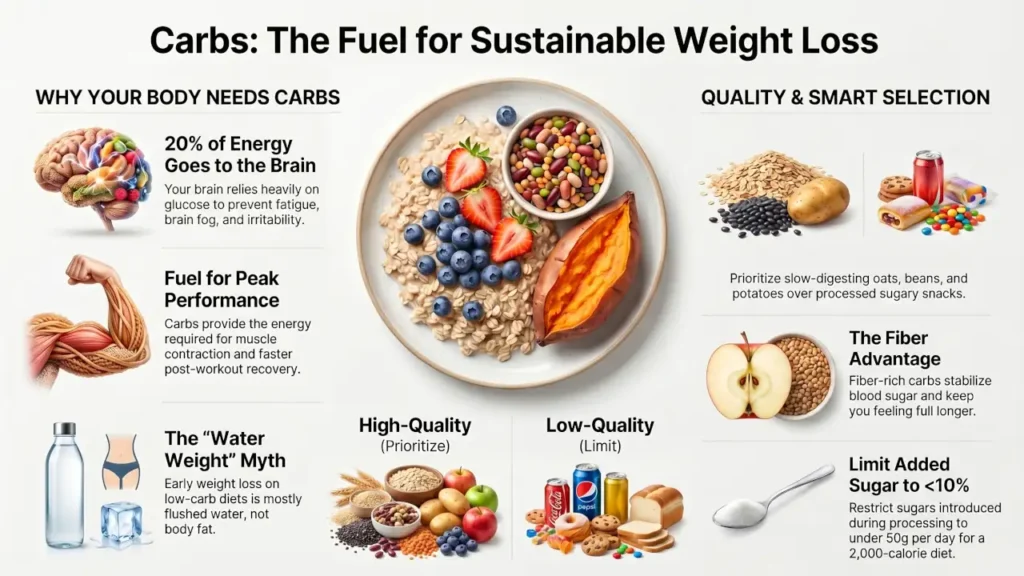
Your brain, in particular, relies heavily on glucose for energy. Despite making up only about 2% of your body weight, it uses roughly 20% of your body’s energy at rest. According to the National Institutes of Health, glucose serves as the brain’s primary fuel source under normal conditions, which helps explain why some people experience fatigue, brain fog, or irritability when carbohydrate intake becomes extremely restrictive. This is why low-carb diets can often lead to brain fog, fatigue, and irritability—your brain is running on empty.
Furthermore, carbohydrates are essential for physical performance. If you’re exercising regularly while severely restricting carbohydrates, you may notice workouts feel harder and recovery takes longer because your body has less readily available fuel. Your body needs readily available energy for muscle contraction during workouts. Adequate carb intake ensures you can perform at your best, burn more calories during exercise, and build metabolically active muscle—all of which support weight loss.
This is especially important for people pursuing body recomposition, where maintaining exercise performance and preserving muscle mass are often priorities alongside fat loss.
Busting the “Carbs Make You Fat” Myth
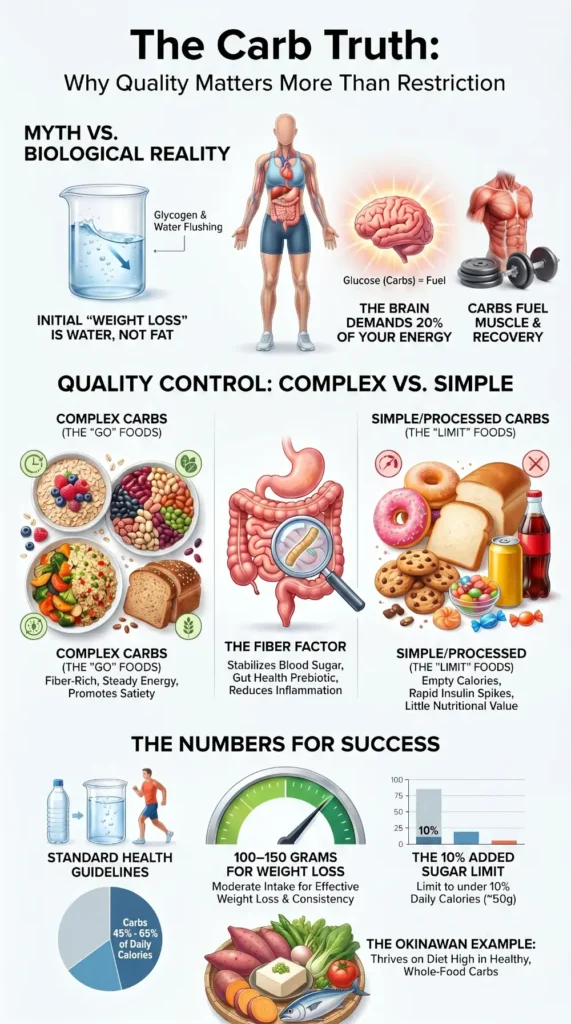
So, how did carbs get such a bad reputation? The confusion often stems from the rapid weight loss seen at the start of very low-carb diets. This initial drop is largely water weight, not fat. Carbohydrates are stored in your muscles and liver as glycogen, and every gram of glycogen is bound to several grams of water. When you slash carbs, you deplete these glycogen stores, and the associated water is flushed out.
This is one reason scale weight can change dramatically after increasing or decreasing carbohydrate intake, even when body fat has not changed much.
It’s easy to see why this causes confusion. The number on the scale drops quickly, but most of that early change is water rather than body fat. The long-term reality is that weight management boils down to a simple energy balance: consuming more calories than you burn leads to weight gain, while a calorie deficit leads to weight loss. You can achieve this deficit with or without carbohydrates.
This is one reason major medical organizations such as the Mayo Clinic emphasize overall diet quality and calorie balance rather than treating carbohydrates as something that must be eliminated for weight loss.
In practice, cutting carbs too aggressively can create new problems. Many people find themselves thinking about food constantly because cravings become harder to manage. Others notice their workouts suffer, which can make it harder to stay active and maintain muscle. Some people simply feel tired all day. These effects don’t happen to everyone, but they’re common enough that extremely low-carb diets are often difficult to sustain long term.
Populations like the Okinawan people, known for longevity and healthy weights, have traditionally consumed diets high in healthy carbohydrates, proving that carbs themselves are not the culprit.
Why Carbs Get Blamed for Weight Gain
Carbohydrates often get blamed for weight gain because many foods people overeat happen to contain carbs. This leads many people to wonder whether carbs make you gain weight, when the bigger issue is usually overall calorie intake and food quality.
Pizza, pastries, chips, cookies, and sugary drinks are common examples. But the issue isn’t necessarily the carbohydrates themselves. It’s often the combination of excess calories, large portions, and highly processed ingredients. Looking at carbohydrates in isolation often misses the bigger picture. Portion sizes, food quality, activity level, and total calorie intake usually have a much larger impact on body weight.
How Many Carbs Should You Eat for Weight Loss?
There is no one-size-fits-all answer, as your ideal carb intake depends on your age, sex, activity level, and metabolic health. However, we can use general guidelines to build a solid starting point.
For most people, official guidelines recommend that carbohydrates make up 45% to 65% of your total daily calorie intake. For someone following a 2,000-calorie diet, this translates to 225 to 325 grams of carbohydrates per day.
For those specifically aiming for weight loss, a moderate intake of 100 to 150 grams per day can be a safe and effective range for many people. For example, someone eating 1,800 calories per day might consume around 180 to 225 grams of carbohydrates if carbs make up 40% to 50% of total calories. The exact number isn’t as important as finding an intake level that supports energy, exercise performance, and long-term consistency.
This is low enough to encourage your body to tap into fat stores but high enough to provide ample energy and nutrients.
As a general starting point, less active adults often do well toward the lower end of the range, while people who exercise regularly usually benefit from a bit more carbohydrate intake. Athletes and highly active individuals often need considerably more because carbohydrates help support training performance and recovery. The important thing is to start with a reasonable target and adjust based on energy levels, hunger, and progress over time.
Before deciding how many carbs to eat, it helps to know how many calories your body actually needs. Start with our Calorie Calculator to estimate your daily calorie needs, then use the Macro Calculator to determine how much of those calories should come from carbohydrates, protein, and fat.
Finding the Right Carb Intake for You
There isn’t a perfect carb intake that works for everyone.
Some people feel great eating 200 grams of carbohydrates per day. Others prefer a lower-carb approach because it helps control hunger.
Activity level matters too. Someone training for long runs has very different carbohydrate needs than someone who spends most of the day sitting at a desk.
If you track macros, carbohydrates are simply one part of the equation alongside protein and fat. If you’re unsure how to balance all three, our Macro Calculator can help you estimate a starting point based on your goals, activity level, and calorie target. Looking at all three nutrients together often provides a clearer picture than focusing on carbs alone, especially when weight loss is the goal.
The best approach is usually the one you can maintain consistently while meeting your nutrition needs and staying within your calorie goals.
Are Some Carbs Better Than Others?
This is where many people get confused about carbohydrates. Not all carbohydrates are created equal. The health impact of carbs depends almost entirely on their quality, which determines how they behave in your body.
Complex vs. Simple Carbs: What’s the Difference?
Complex carbohydrates are generally the foods most people should prioritize. Foods like oats, beans, vegetables, and whole grains digest more slowly and tend to provide steadier energy throughout the day. They’re also naturally rich in fiber, vitamins, and minerals.
One reason fiber-rich carbohydrates are often more satisfying is that they tend to cause a slower rise in blood sugar and insulin levels compared with highly refined carbohydrate sources. This steadier response can help some people maintain more consistent energy throughout the day.
Simple carbohydrates digest much more quickly. Some simple carbs, such as those found in fruit and milk, come packaged with valuable nutrients. Others, particularly those found in sugary drinks, candy, and heavily processed snacks, provide calories without offering much nutritional value. That’s why the source of the carbohydrate matters just as much as the amount.
The Fiber Factor and the Gut-Brain Connection
High-quality carbs are rich in dietary fiber. Fiber is a type of carbohydrate that your body can’t digest. It slows down digestion, stabilizes blood sugar, and helps you feel full with fewer calories.
Research continues to show that carbohydrate quality matters. A large study published in JAMA Network Open found that women who consumed more fiber-rich, high-quality carbohydrates during midlife were more likely to experience healthy aging compared with those consuming more refined carbohydrates.
Emerging research also highlights the importance of the gut-brain axis. The fiber in complex carbs acts as a prebiotic, feeding the beneficial bacteria in your gut. These bacteria, in turn, produce compounds that reduce inflammation and support brain health, creating a positive cycle that benefits your entire body.
Common Mistakes People Make with Carbs
One of the biggest mistakes I see is people cutting out all carbohydrates at once. They remove bread, rice, fruit, beans, and even vegetables with natural starches. For a few days they feel motivated, but eventually energy levels drop and cravings increase.
Another common mistake is replacing whole-food carbs with heavily processed low-carb products. Just because something is labeled keto or low-carb doesn’t automatically make it nutritious.
Many people also avoid fruit because they’re worried about sugar. Whole fruits contain fiber, water, and important nutrients that help support overall health. Eating an apple is very different from drinking a sugary soda.
Finally, some people fear foods like potatoes even though potatoes can be filling, nutritious, and useful in a balanced weight-loss plan.
I’ve also noticed that many people blame carbohydrates when the real issue is that ultra-processed foods are easy to overeat. A bowl of oatmeal and a large pastry are both sources of carbs, but they affect hunger, fullness, and overall nutrition very differently. In many cases, the problem isn’t carbohydrates themselves but the large amount of ultra-processed foods that often accompany them.
What to Eat and What to Limit
If you’re trying to improve the quality of your carbohydrate intake, focus on healthy carbohydrates for weight loss such as oats, beans, potatoes, fruit, vegetables, quinoa, and whole grains.
Whole grains such as oats, barley, and whole-wheat products are especially helpful because they provide carbohydrates alongside fiber and other nutrients that support overall health and satiety.
On the other hand, foods like sugary drinks, pastries, candy, and heavily processed snack foods tend to deliver large amounts of calories without providing much satiety. That’s one reason they can make weight management more difficult.
A useful question to ask yourself is not “Does this food contain carbs?” but rather “What else comes with those carbs?” Foods that provide fiber, protein, vitamins, and minerals are usually very different from foods that provide mostly sugar and refined starch.
How Much Sugar Should You Eat?
This is where we draw a firm line. While the natural sugars in whole fruits and dairy are perfectly healthy because they come packaged with fiber and nutrients, added sugars are the real problem.
Added sugars are those introduced during processing, and they contribute empty calories that promote weight gain and inflammation. The Dietary Guidelines for Americans and the World Health Organization (WHO) recommend limiting added sugars to less than 10% of your total daily calories.
For a 2,000-calorie diet, that’s a maximum of 200 calories from added sugar, which equals about 50 grams or 12 teaspoons per day. However, data shows that the average American consumes 17 teaspoons daily, far exceeding this limit.
Pro Tip: Always read nutrition labels. Look for “Added Sugars” on the Nutrition Facts panel and try to choose products with little to none.
Also Read: Eating Within a 10-Hour Window: The Best Practice to Cut Night Snacking
Your Action Plan: Making Carbs Work for Your Weight Loss
Making carbohydrates work for your weight-loss goals doesn’t have to be complicated. Start by replacing some refined carbohydrates with higher-fiber options. For example, oatmeal can be a better choice than sugary cereal, and brown rice may keep you fuller than white rice.
It also helps to pair carbohydrates with protein and healthy fats. An apple by itself can be satisfying, but pairing it with almonds or Greek yogurt often keeps hunger away longer.
Another simple change is paying attention to what you drink. Sugary beverages can add hundreds of calories without providing much fullness, while water, unsweetened tea, and sparkling water can help reduce overall calorie intake.
Most importantly, focus on building meals around whole foods whenever possible. You don’t need a perfect diet. Consistency matters much more than perfection.
If you’re unsure how many carbs fit your goals, using a calorie calculator or food diary for a week can provide a useful starting point. The goal isn’t perfection. It’s understanding your eating habits so you can make informed adjustments.
How to Know If Your Carb Intake Is Working
Give any meaningful change at least two to four weeks before judging the results.
If your energy improves, workouts feel better, hunger is easier to manage, and weight is moving in the right direction, your current carb intake may be a good fit.
If you’re constantly tired, struggling through workouts, or experiencing intense cravings, you may have reduced carbohydrates too aggressively.
On the other hand, if portions have gradually increased and progress has stalled, reducing some refined carbohydrates may help bring calories back under control.
The Final Word
Eliminating carbohydrates is not a viable, long-term strategy for most people. It’s a quick fix that often leads to burnout, frustration, and yo-yo dieting. The true path to sustainable weight loss is learning to nourish your body with high-quality, nutrient-dense carbohydrates that provide lasting energy, control hunger, and support your overall health.
For many people, carbohydrates for weight loss are not the problem. The bigger factors are overall calorie intake, food quality, and consistency over time.
Carbs are not bad. In many cases, they’re one of the reasons a healthy eating plan actually feels sustainable. Instead of fearing carbohydrates, focus on choosing mostly whole, minimally processed sources and keeping portions aligned with your goals. That’s a strategy most people can stick with long after the latest diet trend fades away.