Vegetables are the foundation of every healthy plate — low in calories, rich in fiber and micronutrients, and essential when you’re trying to lose weight. But when you’re tracking macros in vegetables (protein, carbohydrates, fat) precisely, it’s useful to understand how vegetables add up — especially if you’re aiming for body recomposition or a steady rate of weight loss.
As a nutrition coach, I’m here to give you the straight talk. Tracking might seem complex, but getting it right is the key to unlocking steady, sustainable results. This guide will cut through the confusion and show you the simplest way to handle vegetables in your macro plan, so you can stop guessing and start progressing.
Also Read: What is flexible dieting?
Is a Vegetable a Negative-Calorie Food?
Let’s bust this myth right away. The idea of a “negative-calorie food” – something that takes more energy to eat and digest than it provides – is compelling, but it’s not supported by science.
Foods like celery, cucumbers, and lettuce are incredibly low in calories and over 90% water. While your body does use energy (calories) to digest food—a process known as the thermic effect of food—the amount burned is a small fraction of the food’s calorie content. For example, only about 5-10% of the calories from carbs are used in digestion.
So, while chewing a stalk of celery might burn a calorie or two, it won’t create a calorie deficit on its own. People who lose weight on diets centered around these foods are successful because they are maintaining an overall calorie deficit, not because of any magic calorie-burning property of the food itself.
The Coach’s Takeaway: Don’t rely on “negative-calorie” foods. Instead, focus on how these low-calorie, high-volume foods can help you feel full and satisfied while staying within your macro targets.
Macros of Common Vegetables
Yes, all vegetables contain macros and need to be counted. However, all vegetables are not created equal! The most important distinction for a macro tracker is between non-starchy and starchy vegetables.
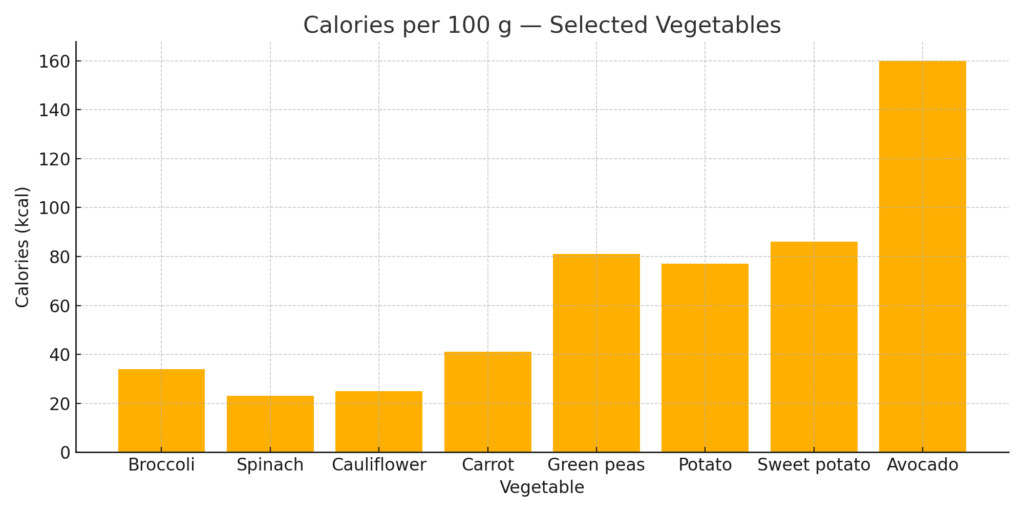
The table below gives you a clear picture of the macro profiles for some of the most common vegetables. Use this as your quick-reference guide.
Non-Starchy Vegetables (Low-Carb)
These are your go-to, high-volume foods. You can eat larger portions for relatively few carbs and calories.
| Vegetable | Serving Size | Calories | Carbs (g) | Protein (g) | Fiber (g) |
| Spinach | 1 cup raw | 8 | 1 | 1 | 0.7 |
| Celery | 1 cup chopped | 16 | 3 | 1 | 1.6 |
| Cucumber | 1 cup sliced | 16 | 4 | 1 | 1 |
| Bell Pepper | 1 medium | 25 | 6 | 1 | 2 |
| Broccoli | 1 cup florets | 31 | 6 | 2.5 | 2.4 |
| Cauliflower | 1 cup chopped | 25 | 5 | 2 | 3 |
| Tomato | 1 medium | 25 | 5 | 1 | 1 |
Starchy Vegetables (Higher-Carb)
These are denser in carbohydrates and calories, so portion control is more important. They are excellent sources of energy and nutrients.
| Vegetable | Serving Size | Calories | Carbs (g) | Protein (g) | Fiber (g) |
| Carrots | 1 cup chopped | 53 | 12 | 1.2 | 3.6 |
| Sweet Potato | 1 medium | 100 | 23 | 2 | 4 |
| White Potato | 1 medium | 110 | 26 | 3 | 2 |
| Corn | 1 cup kernels | 90 | 18 | 4 | 2 |
| Green Peas | 1 cup | 118 | 21 | 8 | 7 |
Tracking Macros in Vegetables
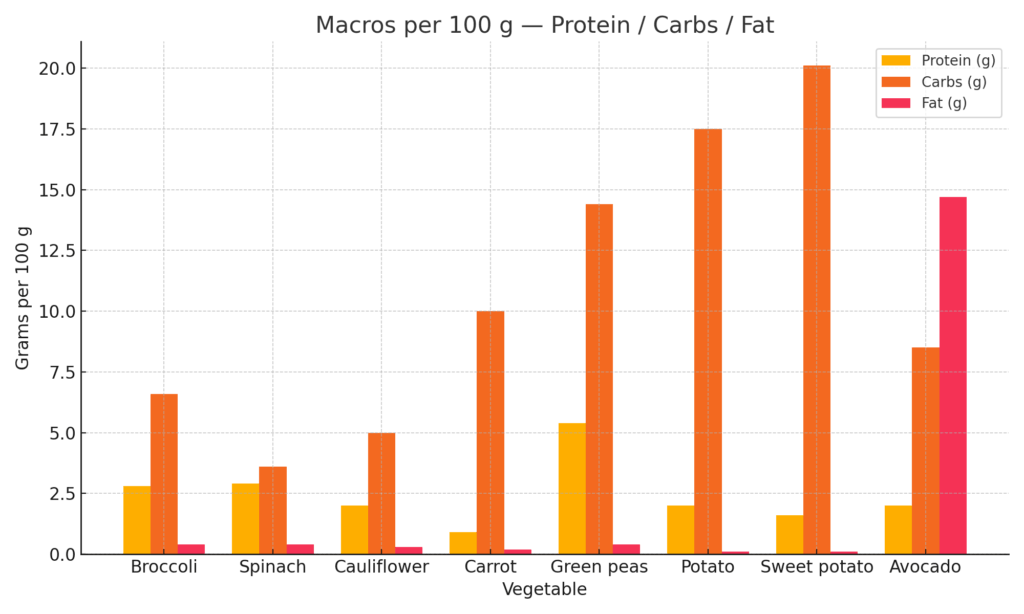
When you track macros, vegetables are not “free” — their carbs (and occasionally fats, e.g., avocado) count toward your daily targets. But they are nutrient-dense and typically help you meet fiber and micronutrient goals without blowing your calorie budget. By not counting them would impact your calorie deficit, slowing results, Hence, it is important to track all foods you consume.
Best Vegetables for Macro Tracking
If you’re trying to hit a protein goal or keep carbs lower, your vegetable choices can make a big difference. The “best” vegetables for macro tracking are those that offer a favorable protein-to-carb ratio and are high in fiber.
These powerhouse veggies give you more nutritional bang for your macro buck:
- Broccoli & Cauliflower: The staples of any macro-friendly diet. They are versatile, low in carbs, and provide a decent amount of fiber and even a little protein.
- Brussels Sprouts: Packed with fiber and protein for a vegetable, making them a highly satisfying choice.
- Kale & Spinach: Leafy greens are incredibly low in calories and carbs. You can add huge handfuls to salads, smoothies, and cooked dishes without significantly impacting your macros.
- Asparagus: A great low-carb option that is easy to prepare and pairs well with any protein source.
Also Read: How Much Fiber to Eat When Counting Macros
Your Simple System for Tracking Vegetable Macros
Feeling overwhelmed? Let’s simplify it into a foolproof system.
- For Non-Starchy Veggies: Weigh them raw for the most accuracy. While they do have macros, if you’re eating a typical serving (like a cup of mixed salad greens), the carb count is so low that some trackers don’t log them. However, if you consume large volumes (e.g., an entire bag of spinach in a smoothie), you should absolutely track it, as the carbs and protein will add up.
- For Starchy Veggies: Always weigh and track them. Cooked and raw weights differ, so choose one method and stick with it. I recommend weighing them after cooking for simplicity (e.g., your baked sweet potato or steamed rice).
- Understanding Net Carbs: Some trackers subtract fiber from total carbs to get “net carbs,” as fiber isn’t digested. Whether you track total or net carbs is a personal preference, but consistency is key. If you are on a keto diet, tracking net carbs is essential.
Coach’s Pro Tip: Don’t get lost in the weeds. If you generally consistent with tracking your meats, grains, and fats, being slightly off on your celery measurement won’t derail your progress. The goal is consistency, not perfection.
Your Next Steps
You now have the knowledge to track vegetables like a pro. Remember, the goal is to use these nutrient-packed foods to fuel your body, reach your macros, and feel amazing throughout your journey.
Ready to put this into practice?
- Calculate Your Needs: Use our TDEE Calculator to find out your daily calorie and macro targets for body recomposition.
- Plan Your Meals: Browse our Meal Prep Recipes for delicious, macro-friendly ideas that make tracking easy.
More information
Checkout out ultimate list of best proteins, carbs, and fats.
View Resources
- USDA FoodData Central (nutrient database). Link
- Harvard / general nutrition context and thermic effect discussion. Link
- Nutrition tables / values for common vegetables (examples from NutritionData / MyFoodData). Link