
Hitting a weight loss plateau is one of the most frustrating parts of any diet. You’ve been careful about your meals, you’ve shown up for workouts, and then the scale decides to stop being friendly. Most people respond by cutting calories even harder or adding more cardio — and that’s usually where things start to backfire.
The good news is that a plateau doesn’t mean failure. It’s a normal physiological response — and it can be nudged, re-tuned, and overcome without cutting your food to nearly nothing. In this article I’ll explain why plateaus happen, how your body adapts, and give you six practical, science-based ways to get moving again.
I’ll also walk you through how to adjust your macros, use zig-zag calorie days, add resistance training, change workout variety, tweak meal timing, and try short-term strategies like intermittent fasting — all without starving yourself. You’ll find clear how-to steps, practical tracking tools, and a short real-life story that shows how simple changes can break the stall. Think of this as coaching from a trusted friend who cares about your health, not a lecture. Let’s get you unstuck.
Also Read: 10 Evidence-Based Benefits of Hiring a Nutrition Coach
How to Break a Weight Loss Plateau (Quick Answer)
To break a weight loss plateau:
- Recalculate your calorie needs after weight loss.
- Increase protein to preserve muscle.
- Add 2–3 weekly strength training sessions.
- Adjust calories using zig-zag or cycling methods.
- Monitor sleep, stress, and water retention.
- Track progress for 3–6 weeks before changing strategy again.
Most plateaus are caused by metabolic adaptation, reduced daily movement, or inaccurate calorie tracking — not a broken metabolism.
What is a Weight Loss Plateau — and Why it Happens
A weight loss plateau is when progress stalls: you’re following your plan, but the numbers on the scale stop dropping for weeks. This happens because the body adapts. As explained by the Mayo Clinic in their overview of getting past a weight-loss plateau, resting energy needs decline as body weight drops, making the same calorie intake less effective over time.
When you lose weight, your resting energy needs drop, and hormonal changes increase hunger and reduce energy expenditure. This is why recalculating your intake using a structured TDEE calculator can help ensure your calorie deficit is still appropriate for your current body weight.
This process is sometimes referred to as adaptive thermogenesis — your body becoming more efficient at conserving energy as weight decreases. This metabolic slowdown is one reason people ask, “Why did my weight loss stop even though I’m eating the same?”
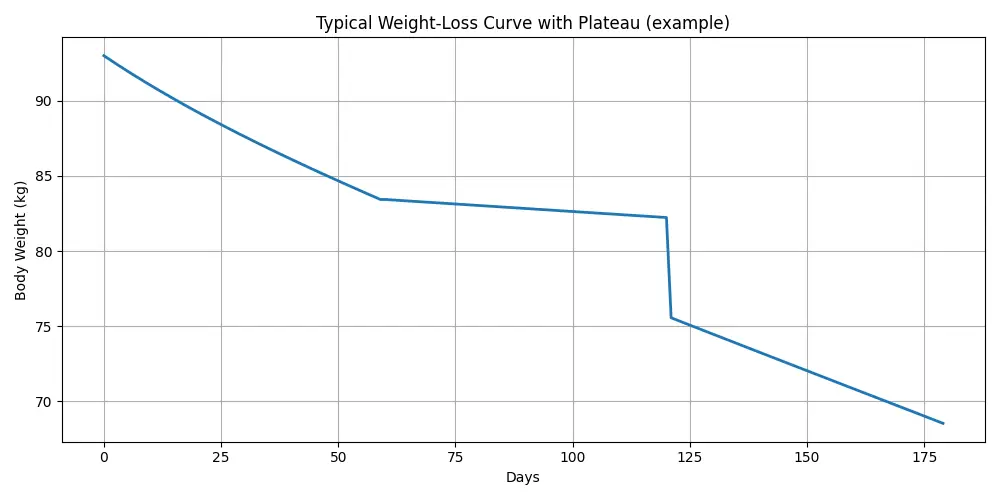
You may also be losing some muscle along with fat, which lowers your metabolic rate. Other common contributors include underestimating how many calories you’re eating, overestimating exercise, increased water retention (from salt, exercise, hormones), or medication and sleep issues. Understanding the cause is the first step to choosing the right fix.
It’s also important to remember that a stall on the scale does not always mean fat loss has stopped. Water retention, hormonal fluctuations, and glycogen changes can temporarily mask fat loss progress.
What Causes a Weight Loss Plateau?
Plateaus come from several forces working at once. First, as you lose body mass you burn fewer calories each day. That makes the same eating and exercise pattern less effective. Second, your hormones respond: hunger hormones can rise and satiety hormones fall, pushing you to eat more.
Third, small changes in your day-to-day choices add up — extra teaspoons of oil, a few bites of a snack, or drinks with calories. Finally, if you cut calories aggressively, your body may go into an energy-saving mode where it slows non-essential processes and reduces movement. All of these things conspire to make weight loss slower or stop. If you know which of these is dominant for you, you can pick the best strategy to fix it.
6 Ways to Break a Weight Loss Plateau (No Starving Required)

Here are six actionable, evidence-informed strategies. Each one is something you can do without severe hunger or extreme restriction.
I’ve seen this pattern repeatedly: people hit a weight loss plateau, double their cardio, slash calories further, and end up more exhausted but no leaner. The solution is rarely “more punishment.” It’s smarter adjustments.
1) Alter your Macronutrient Intake
Switching the proportion of protein, carbs, and fat in your daily intake is one of the most effective, low-stress ways to restart progress. Increasing protein helps preserve muscle, raises satiety, and slightly increases the calories burned during digestion. If your diet is high in carbs, try reducing some carbohydrate servings and replacing them with lean protein.
If you’re unsure how protein, carbs, and fats work together, it helps to understand the three primary macronutrients and how they influence appetite and energy balance. If your intake is currently carb-heavy, one simple adjustment is to shift toward more protein and slightly fewer refined carbs — a strategy often used in carb cycling approaches.
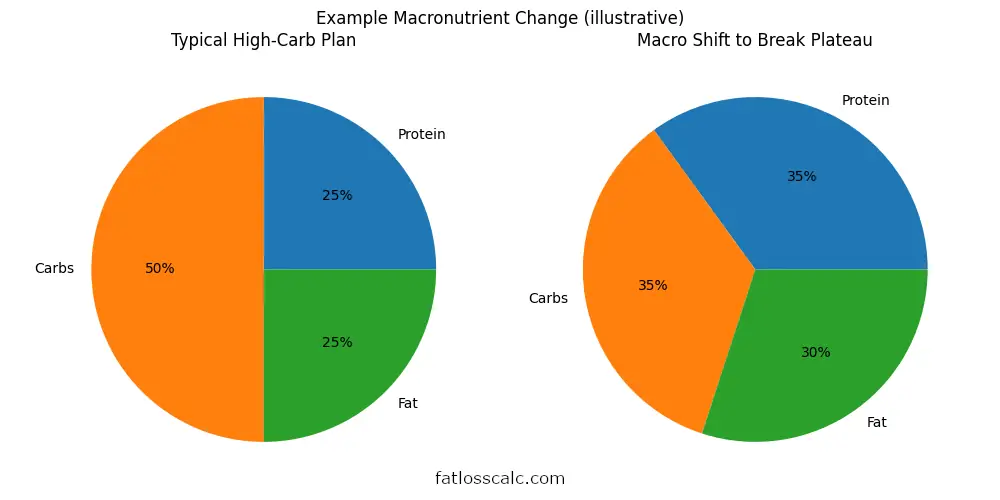
If tracking feels overwhelming, learning a simple method of losing weight by tracking macros or body recomposition can provide structure without obsession. It’s also important to remember that eating too little can stall your weight loss, especially if calories have been very low for a long period.
For those who prefer exact numbers, you can estimate personalized targets using a macronutrient weight loss calculator and adjust gradually over 3–4 weeks rather than making drastic cuts.
2) Zig-zag your Calories
Instead of a fixed calorie intake every single day, try planned variation: higher-calorie training days and lower-calorie rest days. This approach helps you avoid long stretches of constant deficit that promote metabolic adaptation. Zig-zagging can also help performance and energy for harder workouts.
Practically, pick 2–3 higher calorie days per week (usually when you do harder workouts) and make the rest of the week slightly lower, so your weekly calories still give a modest deficit. Many athletes and coaches use this approach because it improves adherence and reduces the feeling of deprivation.
3) Add Strength Training to your Routine — Preserve and Build Muscle
Muscle is metabolically active. The more muscle you maintain or build while losing fat, the higher your daily calorie burn. If your plan has relied only on cardio, add 2–3 resistance sessions per week.
Compound moves like squats, presses, rows, and deadlifts give the most “bang for buck.” If you’re new to resistance training, start with bodyweight work and slowly add weights. For an evidence-backed boost when you also want short, intense work, HIIT plus resistance has shown good improvements in body composition.
If you want a specific read on interval training and how it increases results, if you want structured programming ideas, especially for intervals combined with strength, research supports increased success with HIIT training when paired with resistance work.
For beginners, a simple starting program is: two full-body sessions focusing on 3 sets of 8–12 reps for the main lifts. Over weeks, add weight slowly. Trials show combined HIIT and resistance training improves body composition and fitness. Research published in PubMed Central supports combining HIIT and resistance training for improvements in fat loss and lean mass retention. Harvard’s Nutrition Source also explains how high-intensity interval training can be an efficient tool when paired with strength work.
4) Change your Exercise Routine — Your Body Adapts to the Same Stress
Doing the same workouts week after week can reduce the stimulus your body receives. Introduce variety: change the movement patterns, adjust rep ranges, or swap modalities (elliptical one week, cycling the next). If you’ve only been doing steady-state cardio, try some interval work. If you always lift heavy, try a week of higher reps and more volume, or vice versa. The goal is to provide a new stimulus so your body has to respond. Short-term changes often re-sensitize your training response and can push fat loss again. Evidence supports alternating modalities to produce better adherence and sometimes greater fat loss than monotonous conditioning.
5) Change your Meal Frequency and Timing Smartly
Sometimes the problem isn’t what you eat, it’s when you eat. Adjusting meal frequency — for example, shifting to fewer, larger meals or trying time-restricted eating — can help reduce daily calorie intake naturally for some people.
Before making big changes, calculate your estimated maintenance intake using a reliable TDEE calculator, then adjust by small increments rather than large calorie swings. If you prefer time-restricted eating or short fasts, you can experiment with a 12:12 or 14:10 window, but be cautious of inconsistent evidence.
A systematic review published on PubMed Central found that intermittent fasting can produce weight loss, but its advantage over standard calorie restriction is mixed. That means it works for some people — but it is not magic. Keep in mind the quality and quantity of food matter most; meal timing is a tool, not a magic fix.
6) Short-term “Plateau Breakers” you can try
When a plateau persists, try short, targeted experiments rather than permanent overhauls. Examples include a 2-week protein-focused reset, a 10-day structured zig-zag plan, or a brief reduction of processed snacks. Another option is a short refeed day (higher carbs) timed around heavy training to improve hormones and training performance. You can also try more mindful or intuitive eating for a few weeks to retrain hunger cues; this article on intuitive eating explains how listening to hunger and fullness can help with long-term change: eat more intuitively. Any experiment should be short and measurable so you know what works for you.
If I had to prioritize, I would start with two changes: increase protein and add resistance training. These two adjustments protect muscle, support metabolism, and improve long-term fat loss sustainability more than simply cutting more calories.
Macronutrient Plateau Breakers
If you spend too long on low protein and high carbs, your appetite can go up and your muscle can go down. Try this simple, 4-week protocol:
- Week 1: Increase protein by 20 grams at breakfast and lunch. Keep total calories roughly the same.
- Week 2: Shift 10–15% of calories from carbs to protein. Track progress and energy. Use the macronutrient weight loss calculator if you want exact numbers: macronutrient weight loss calculator.
- Week 3–4: Maintain higher protein, add two resistance sessions per week, and reassess weight and strength.
Small changes compound. Most people feel less hungry and maintain better performance when protein is raised moderately. If appetite is still high, consider increasing fiber-rich vegetables and water intake too.
How to Start Resistance Training?
If resistance training is new, start easy to avoid injury and build confidence. Pick 2 full-body sessions per week with one exercise per major muscle group. A sample workout:
- Bodyweight squats or goblet squats, 3 sets of 8–12
- Push-up or incline push-up, 3 sets of 8–12
- Dumbbell or bent-over row, 3 sets of 8–12
- Plank, 2–3 sets of 30–60 seconds
Increase load or reps slowly. Short, consistent progress beats rare hardcore sessions. If you want interval-style sessions that combine cardio and strength, see this guide on interval training: increased success with HIIT training.
Ten Practical Exercise Ideas to Break a Weight Loss Plateau
- Short HIIT bike sprints after a strength session.
- Supersets in resistance training to increase intensity (push/pull back-to-back).
- Elevated step-ups with dumbbells to build leg strength and caloric burn.
- Rowing intervals (1 minute hard, 1 minute easy) for total-body conditioning.
- Loaded carries (farmer’s walks) to build core and grip strength.
- Kettlebell swings for posterior chain and conditioning.
- Circuit training: 4–6 exercises, 3 rounds, short rest.
- A long low-intensity walk on recovery days to increase NEAT.
- Hill sprints or stair sprinting for short, high-intensity bursts.
- A week of higher-rep strength work (12–15 reps) to create a new stimulus.
Each idea can be adapted for beginners or seasoned exercisers. The point is to change something so your body must adapt.
A True Story of Breaking a Weight Loss Plateau
Carolyn was 34 and had lost 12 kg over six months. Then the scale stalled for six weeks. She felt frustrated and started skipping meals, which only made her tired. We changed three things for four weeks.
First, she increased protein at breakfast and lunch by adding eggs and Greek yogurt. Second, we replaced two long, easy cardio sessions with two strength workouts. Third, she did zig-zag calories — higher on training days and lower on easy days.
She tracked results weekly. After three weeks the scale moved again and she felt stronger. The change didn’t require starving; it required smarter choices and small experiments.
Small Mistakes that Keep Plateaus Alive
It’s rarely one big thing. Typical small errors include not tracking liquid calories, forgetting the tablespoon of oil used in cooking, eating larger portions when stressed, and compensating for workouts with extra snacks. Sleep and stress also matter — poor sleep increases hunger hormones and reduces willpower. Fixing small leaks often restarts progress faster than dramatic changes.
How to Test What Works for You — A Simple 6-Week Experiment
- Week 0: Baseline weigh-in, body measurements, and a TDEE calculation using the tdee calculator.
- Weeks 1–3: Pick one main strategy — increase protein and add two resistance workouts. Keep other habits consistent. Use weekly weigh-ins and measurements.
- Weeks 4–6: If stalled, introduce zig-zag calories or a short intermittent fasting window using the intermittent fasting calculator. Track how you feel and performance. Adjust based on evidence from week 1–3.
Short, repeatable experiments tell you what actually works for your body.