Most people don’t think twice about vegetables when they start tracking macros. Then a week later they’re standing in the kitchen wondering if onions, carrots, peas, or corn “count” enough to log.
I’ve seen this happen a lot with people trying to lose weight. Some ignore vegetables completely. Others go the opposite direction and start weighing every spinach leaf like it’s a slice of cake. Usually, the best approach is somewhere in the middle.
The truth is that tracking macros in vegetables matters more for some vegetables than others. A bowl of lettuce and cucumber barely changes your daily intake. But starchy vegetables like potatoes, peas, and corn can add up quickly if portions get bigger than expected.
You don’t need perfection here. You just need a consistent system that makes sense in real life.
Also Read: What is flexible dieting?
Quick Answer: Tracking Macros in Vegetables Explained
Yes, but not all vegetables need the same level of attention.
Low-calorie vegetables like lettuce, spinach, cucumber, celery, and zucchini usually have minimal impact on daily calorie intake unless eaten in very large amounts. Starchy vegetables like potatoes, peas, corn, and sweet potatoes contain more carbohydrates and should generally be tracked more carefully.
For most people, tracking vegetable macros is about consistency rather than perfection. The biggest calorie mistakes usually come from cooking oils, sauces, dressings, and oversized portions rather than leafy greens themselves.
Quick List of the Best Vegetables for Macro Tracking
The best vegetables for macro tracking are broccoli, cauliflower, spinach, kale, brussels sprouts, zucchini, and asparagus because they are filling, high in fiber, and relatively low in calories and carbohydrates compared to starchy vegetables.
Is a Vegetable a Negative-Calorie Food?
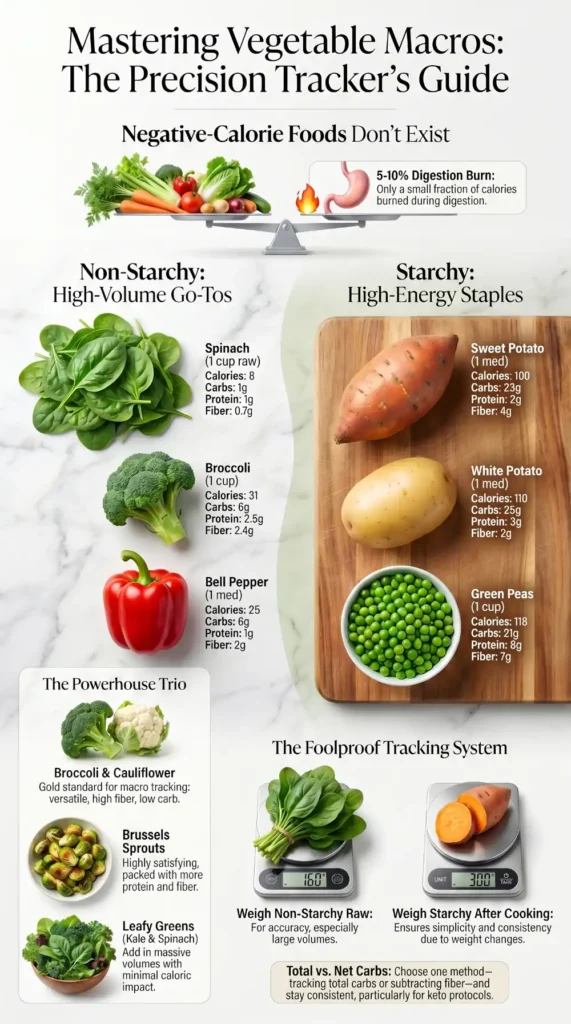
This idea sounds appealing, but it is not actually how digestion works. The idea behind negative-calorie foods is that digestion supposedly burns more calories than the food itself provides.
Foods like celery, cucumbers, and lettuce are extremely low in calories because most of their volume comes from water and fiber. While your body does use energy (calories) to digest food—a process known as the thermic effect of food—the amount burned is a small fraction of the food’s calorie content. For example, only a small percentage of calories are burned during digestion through what researchers call the thermic effect of food, which is explained well by the Cleveland Clinic.
So, while chewing a stalk of celery might burn a calorie or two, it won’t create a calorie deficit on its own. People who lose weight on diets centered around these foods are successful because they are maintaining an overall calorie deficit, not because of any magic calorie-burning property of the food itself.
The better way to think about these foods is simple. Vegetables can help you stay full while keeping calories lower overall, but they are not doing anything magical. Weight loss still comes down to your overall eating habits and calorie intake over time.
Macros of Common Vegetables: Understanding the Macros of Vegetables
Yes, all vegetables contain macros and need to be counted. However, all vegetables are not created equal! The most important distinction for a macro tracker is between non-starchy and starchy vegetables.
Tracking Macros in Vegetables: Non-Starchy Vegetables
These are your go-to, high-volume low-carb vegetables. You can eat larger portions for relatively few carbs and calories.
| Vegetable | Serving Size | Calories | Carbs (g) | Protein (g) | Fiber (g) |
| Spinach | 1 cup raw | 8 | 1 | 1 | 0.7 |
| Celery | 1 cup chopped | 16 | 3 | 1 | 1.6 |
| Cucumber | 1 cup sliced | 16 | 4 | 1 | 1 |
| Bell Pepper | 1 medium | 25 | 6 | 1 | 2 |
| Broccoli | 1 cup florets | 31 | 6 | 2.5 | 2.4 |
| Cauliflower | 1 cup chopped | 25 | 5 | 2 | 3 |
| Tomato | 1 medium | 25 | 5 | 1 | 1 |
Starchy Vegetables (Higher-Carb)
These are denser in carbohydrates and calories, so portion control is more important. They can also be useful when you need more carbohydrates for training, activity, or overall calorie intake.
| Vegetable | Serving Size | Calories | Carbs (g) | Protein (g) | Fiber (g) |
| Carrots | 1 cup chopped | 53 | 12 | 1.2 | 3.6 |
| Sweet Potato | 1 medium | 100 | 23 | 2 | 4 |
| White Potato | 1 medium | 110 | 26 | 3 | 2 |
| Corn | 1 cup kernels | 90 | 18 | 4 | 2 |
| Green Peas | 1 cup | 118 | 21 | 8 | 7 |
Why These Macros Matter
When people start tracking macros, they sometimes assume vegetables are free foods that do not need attention at all. That usually is not a big issue with foods like lettuce or cucumber, but it becomes more important with higher-carb vegetables like potatoes, peas, or corn. According to the USDA FoodData Central database, even healthy foods can contribute meaningful calories once portions grow larger.
When Tracking Vegetable Macros Actually Matters
One mistake people make is treating every vegetable the same.
In real life, most non-starchy vegetables barely affect your calorie intake unless portions get very large. Spinach, lettuce, cucumber, zucchini, broccoli, and cauliflower are usually low enough that strict tracking is less important for general weight loss.
Starchy vegetables are different. Potatoes, corn, peas, and sweet potatoes contain more carbohydrates and calories than people often expect, especially once butter, oil, or sauces get involved.
If your goal is basic weight loss, consistency matters more than perfect accuracy. But if you are trying to follow strict macros, preparing for a bodybuilding cut, or troubleshooting a fat loss plateau, tracking vegetable macros more carefully can help.
For most people, the answer is somewhere in the middle. You do not need to obsessively log every lettuce leaf, but completely ignoring vegetable calories can also create tracking errors over time, especially with starchy vegetables or restaurant meals. This is usually where small calorie differences start adding up without people realizing it.
The Best Vegetables for Macro Tracking
Some low-calorie vegetables make macro tracking easier because they are filling without adding many calories overall.
Broccoli and cauliflower are popular for a reason. They work in almost any meal, contain fiber, and stay relatively low in carbs. Spinach and kale also work well because you can eat a fairly large portion without significantly affecting your daily calories.
Brussels sprouts are slightly higher in carbs than leafy greens, but they are also more filling and contain more fiber. Fiber is one reason vegetables help many people stay in a calorie deficit without feeling as hungry throughout the day.
Some vegetables also contribute small amounts of protein, which is one reason foods like broccoli, kale, and brussels sprouts are popular in higher-volume diets.
Asparagus is another good option when you want something low calorie that pairs well with proteins like chicken, fish, or eggs.
The main thing is choosing vegetables you will realistically keep eating. A “perfect” vegetable is useless if you hate it and stop buying it after one week.
In most cases, the best vegetables for macro tracking are the vegetables that help you stay full, fit easily into meals, and are realistic enough to eat consistently long term.
Also Read: How Much Fiber to Eat When Counting Macros
Your Simple System for Tracking Vegetable Macros
Tracking vegetable macros gets much easier once you stop trying to make it perfect.
For non-starchy vegetables, accuracy matters less than consistency. A normal serving of lettuce, cucumber, spinach, or celery will not dramatically change your daily calories. But if you regularly eat very large portions, like multiple cups blended into smoothies or very large salads with calorie-heavy toppings, it makes sense to track them more carefully.
Starchy vegetables deserve more attention because the carbs add up faster. Potatoes, corn, peas, and sweet potatoes can easily shift your calorie intake if portions get larger than expected. The important thing is using the same measurement method each time. Some people track cooked weights, others track raw. Either approach works if you use the same method consistently.
Some people also track net carbs instead of total carbs, especially on lower-carb or keto diets. Net carbs subtract fiber because fiber is not fully digested by the body. For most people focused on general fat loss, total calorie intake matters more than obsessing over tiny carb differences.
If you are still unsure how many carbs, fats, or proteins you should actually aim for each day, using a macro calculator, calorie deficit calculator, or calorie tracking app can make vegetable tracking much easier because you have clearer daily targets to work with.
One of the biggest mistakes people make is becoming overly strict with low-calorie vegetables while ignoring higher-calorie extras like oils, dressings, sauces, and snacks.
I’ve also noticed that people often underestimate restaurant vegetables because they assume anything with vegetables is automatically low calorie. In reality, the cooking oils and sauces usually matter far more.
In most cases, those foods affect progress far more than being slightly off on broccoli or spinach.
Frequently Asked Questions About Tracking Vegetable Macros
Your Next Steps
Most people eventually realize that some vegetables deserve closer tracking while others barely affect calorie intake at all. The goal is not perfection. It is building eating habits that are realistic enough to maintain consistently over time.
The goal of tracking vegetable macros is not to create a perfect diet spreadsheet. It is simply a way to stay more aware of your eating habits and make adjustments when needed.
Most people do better when they keep things simple. Focus on consistency first, then tighten up accuracy only if progress stalls.
After a while, portion awareness usually becomes more natural, and most people stop needing to track every vegetable so closely.
If you want to improve macro tracking further, it also helps to understand how protein, carbohydrates, fats, and fiber work together across full meals instead of focusing only on individual foods.
Final Thoughts on Tracking Vegetable Macros
Tracking vegetable macros does not need to become obsessive to be effective.
For most people, the biggest results come from staying consistent with meals, paying attention to portions, and being honest about higher-calorie additions like oils, sauces, and dressings.
Low-calorie vegetables like spinach, lettuce, broccoli, zucchini, and cauliflower usually have a small impact on calorie intake, while starchy vegetables deserve closer attention because their carbohydrates add up more quickly.
The goal is not to create a perfect diet spreadsheet. It is to build eating habits that are realistic enough to maintain long term without making food stressful.