
Most people don’t struggle with carb cycling because it’s “too advanced.” They struggle because they start cycling carbs before they understand calories, consistency, or their own training demands.
I’ve seen this play out repeatedly: someone slashes carbs on rest days, overloads them on training days, but never actually checks whether their total weekly intake supports fat loss or performance. When results stall, carbs get blamed — even though the real issue is mismatched expectations.
Carb cycling can be useful. But it’s also easy to misuse. Without a clear calorie framework, it often becomes another form of diet hopping that feels productive but delivers inconsistent results.
The goal of this guide isn’t to convince you that carb cycling is necessary. It’s to show where it fits, where it doesn’t, and how it compares to a flexible, macros-based approach that already adjusts carbs naturally.
If you’re trying to lose fat, fuel training, or simply stop feeling confused about carbs, understanding these distinctions matters more than following any rigid plan.
In this article, I’ll break down carb cycling using practical nutrition principles and current research so you can decide whether it fits your goals — or whether a simpler approach works just as well.
Also Read: How to Calculate Macros If You’re Overweight
What Is Carb Cycling?
Carb cycling is a nutrition strategy where carbohydrate intake is adjusted based on activity level—higher on training days and lower on rest days—while total calories and protein remain controlled.
The goal is to better match energy intake with energy demand, not to eliminate carbohydrates or manipulate metabolism.
This approach is often used alongside flexible dieting or macro tracking, rather than as a standalone diet.
Are Carbs Good or Bad?
A common myth in dieting is that carbs are somehow inherently “bad”—but that’s simply not true. In fact, Carbs are Not Bad for you when consumed appropriately. Carbohydrates are your body’s preferred fuel source, especially for the brain and for high-intensity exercise.
Being in a calorie deficit—not cutting carbs entirely—is what drives fat loss. A deficit occurs when you consume fewer calories than your body burns over time. You can calculate and manage that deficit precisely with a calorie deficit calculator.
Many people who avoid carbs completely end up sacrificing performance, mood, or both. Instead, a thoughtful carb strategy like carb cycling lets you leverage their benefits without over-consuming them on days your body doesn’t need as much.
Carb Cycling vs Macro Counting
Many people ask: Is carb cycling better than counting macros?
Here’s the honest truth:
Macronutrient tracking inherently incorporates a form of carb cycling because your body naturally needs more carbs on workout days and fewer on rest days. In that sense, macro counting can be just as effective—and far less rigid—than traditional carb cycling.
You don’t need to focus only on carbs; instead, macro counting gives you the framework to intuitively adjust carbs as needed.
Carb Cycling with a Flexible Macros-Based Diet
One of the best ways to approach carb cycling is through a flexible macros-based diet (also called flexible dieting). This style of eating uses your total daily energy expenditure (TDEE) to determine how many calories and macros you should aim for each day. You can calculate that using a TDEE calculator.
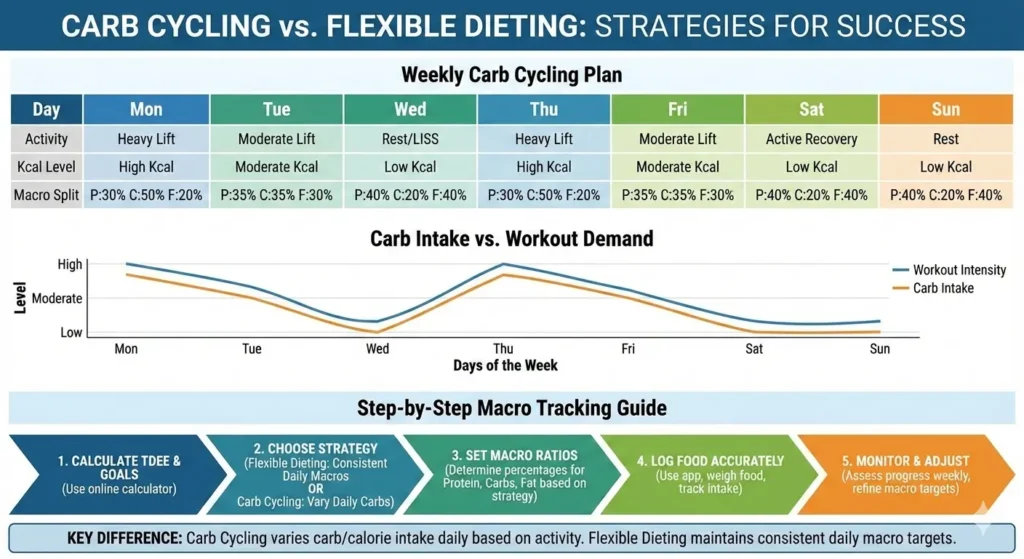
How This Works
- Calculate your daily calorie needs: This tells you how many calories your body requires to maintain your current weight.
- Set your macro targets: Decide how much protein, fats, and carbs you want each day (based on your goals).
- Adjust carbs based on activity:
- Rest days: Lower carb intake because energy needs are lower
- Training days: Higher carb intake to fuel workouts and support recovery
What’s powerful here is flexibility. You’re not rigidly confined to one number each day—you adapt your carb intake within your macro targets based on energy needs.
Example: Carb Cycling with Flexible Dieting
Let’s bring this to life with a real-world example:
Meet Sarah:
Using a macro calculator, she gets daily macro targets based on her TDEE and goals: protein at 30–35% of calories, fats at 25–30%, and carbs making up the remaining calories.
Now, she adjusts carbs like this:
| Day Type | Carb Target (grams) | Protein | Fat |
| Rest Day | 125g | 150g | 60g |
| Moderate Workout Day | 200g | 150g | 50g |
| High-Intensity Day | 240g | 150g | 40g |
Carbs go up on workout days to fuel performance and muscle glycogen, and drop on rest days to help maintain a calorie deficit. All within her macro targets.
Common Carb Cycling Mistakes
Even though carb cycling sounds strategic, most people make the same few errors:
1. Cycling carbs without controlling calories
Raising carbs on training days only works if lower-carb days actually compensate. Otherwise, weekly calories creep up and fat loss stalls.
2. Dropping carbs too low on rest days
Aggressively low-carb rest days often lead to poor recovery, low energy, and overeating later in the week.
3. Treating carb cycling as a fat-loss guarantee
Carb timing can improve performance, but it does not override total calorie intake or protein adequacy.
4. Using carb cycling too early
Beginners often do better mastering basic macro consistency before adding complexity.
Tradeoffs and Limitations to Consider
Carb cycling is not universally better — and it comes with tradeoffs:
- Higher complexity: Planning multiple carb targets increases tracking fatigue.
- Adherence risk: More rules can reduce long-term consistency.
- Not ideal for everyone: People with medical conditions, high stress, or irregular schedules may struggle with frequent adjustments.
For many people, a consistent macro plan with small intuitive carb shifts works just as well — and is easier to maintain.
Also Read: Macros for Gaining Muscle and Cutting Fat
Does Carb Cycling Work for Fat Loss?
Carb cycling can support fat loss, but it does not cause fat loss on its own.
Fat loss still depends on:
- A sustained calorie deficit
- Adequate protein intake
- Consistency over time
Carb cycling mainly helps by aligning higher-carb intake with training days, which may improve performance and adherence.
Final Takeaway
Carb cycling is not a magic bullet—but when combined with flexible dieting and thoughtful macro planning, it becomes a powerful tool for performance, fat loss, and sustainability. Instead of fearing carbs, learn to time and balance them within your overall goals. And remember: long-term success is about consistency and progress—not perfection.
Ready to take control of your macros? Try this macro calculator to get started.
Frequently Asked Questions
View Sources
- Hall KD et al., Energy balance and body weight regulation, American Journal of Clinical Nutrition
- Helms ER et al., Evidence-based recommendations for natural bodybuilding contest preparation, Journal of the International Society of Sports Nutrition
- Slater G, Phillips SM, Nutrition guidelines for strength sports, Medicine & Science in Sports & Exercise