
If you’re searching for macros for gaining muscle and losing fat, there’s a good chance you’ve already tried both extremes. One phase turns into eating everything to “build muscle.” The next becomes cutting calories hard to undo the weight gain. Most people don’t quit because they’re unmotivated — they quit because this constant back-and-forth is exhausting and confusing.
The issue isn’t willpower. It’s the strategy behind it.
Macros aren’t a shortcut or a magic formula. They’re simply a way to stop guessing. When progress stalls, it’s rarely because protein stopped working or carbs suddenly became harmful. More often, calories creep too high or too low, changes happen too quickly, or expectations are set by highlight reels instead of real physiology.
Here’s the part most people don’t expect: using macros for gaining muscle and losing fat works best when progress feels almost boring. The scale doesn’t swing wildly. Instead, strength inches up, waist measurements slowly trend down, and muscle stays in place while fat comes off over time.
This guide is built for that middle ground. Not extreme bulking. Not aggressive cutting. Just clear macro priorities, realistic timelines, and practical adjustments that still hold up when weeks aren’t perfect.
Also Read: Carb Cycling
How to Calculate Macros to Gain Lean Muscle (Lean Bulking)
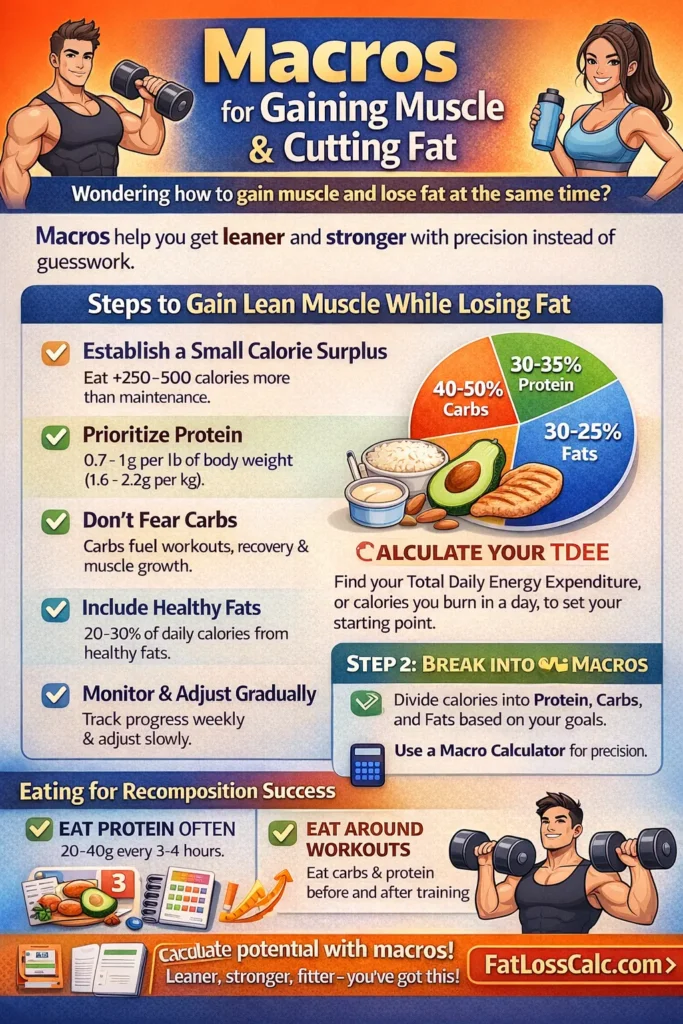
Traditionally, muscle gain and fat loss recommendations were separate phases — the “bulk” for muscle and the “cut” for fat. While this classic approach still works for competitive bodybuilders, most modern lifters prefer a lean bulk or body recomposition strategy. That means gaining muscle while minimizing fat gain — or even losing fat as you build strength.
This focus on improving body composition is the heart of our macro strategy because it’s sustainable and works efficiently for most lifters and fitness enthusiasts.
Steps for a Lean Bulk Using Macros
- Establish a Small Caloric Surplus: The goal is to eat slightly more than your body burns. A surplus of 250-500 calories per day above your maintenance level is ideal for promoting muscle growth with minimal fat gain. This typically results in a weight gain of about 0.25-0.5% of your body weight per week.
- Prioritize Protein: Protein is essential for muscle repair and synthesis. Aim for 0.7 to 1 gram of protein per pound of body weight daily (or 1.6 to 2.2 grams per kilogram) . For a 180-pound individual, this translates to 126-180 grams of protein per day.
- Don’t Fear Carbohydrates: Carbs are your body’s primary energy source for intense weight training. They replenish muscle glycogen, allowing you to train harder and recover better. After setting protein, a solid starting point is to allocate 40-50% of your total daily calories to carbohydrates.
- Include Healthy Fats: Dietary fats are crucial for hormone production, including testosterone, which plays a role in muscle building. Ensure 20-30% of your daily calories come from healthy fats. This is approximately 0.3-0.4 grams per pound of body weight.
- Adjust Based on Your Body: Monitor your progress for 4-6 weeks. If you’re gaining weight too quickly (more than 1-1.5 lbs per week), slightly reduce your carb or fat intake. If you’re not gaining strength or weight, increase your surplus slightly, primarily from carbs.
A Note on Body Recomposition
For those whose primary goal is to lose fat while building muscle (recomp), the strategy shifts to eating at maintenance calories or a very slight deficit while following the high-protein, strength-training principles outlined below. You can find a precise plan tailored to this goal using our dedicated body recomposition calculator.
Steps to Calculate the Best Macro Ratio for Muscle Gain
STEP ONE: Calculate Your TDEE
Your Total Daily Energy Expenditure (TDEE) is the number of calories you burn in a day through all activities. It’s the foundational number for any nutrition goal. You can calculate it manually using the Mifflin-St Jeor equation (which considers age, gender, weight, height, and activity level) , or use a reliable TDEE calculator. Knowing your TDEE tells you your maintenance calories—the number to eat to stay the same weight.
STEP TWO: Calculate Your Muscle Gain Macros
Once you have your TDEE, add your chosen surplus (e.g., +300 calories). Now, break this new total calorie target into macros.
- Protein: Calculate using your body weight (0.7-1g/lb). Each gram of protein provides 4 calories.
- Example (180lb person): 180g protein x 4 cal/g = 720 calories from protein.
- Fats: Aim for 20-30% of your total calories. Each gram of fat provides 9 calories.
- Example (3000 calorie target): 3000 x 0.25 = 750 calories ÷ 9 cal/g = ~83g of fat.
- Carbohydrates: Fill the remaining calories with carbs (also 4 calories per gram). Remember, carbs are not bad; they are a vital fuel source for athletes .
- Example: 3000 total calories – 720 (protein) – 750 (fat) = 1530 calories remaining.
- 1530 calories ÷ 4 cal/g = ~383g of carbohydrates.
For a personalized breakdown in seconds, you can use a macro calculator, which handles all these formulas for you.
Common Macro Mistakes That Stall Progress
Even with “perfect” macro targets, these mistakes can quietly undo results:
Do You Need a Lot of Calories to Build Muscle?
You need a sufficient amount of calories, not necessarily a lot. Muscle growth is an energy-intensive process, so you must be out of a calorie deficit. However, the surplus needed is smaller than many think. As discussed, a modest surplus of 250-500 calories is perfect. Eating far beyond this (“dirty bulking”) primarily leads to fat gain, which you’ll later have to cut back, making the process longer and less efficient.
Can You Build Muscle on Maintenance Calories?
Yes, this is the core premise of body recomposition. It is most effective for:
How Your Body Loses Fat
Fat loss occurs when you consume less energy than you expend, creating a calorie deficit. Your TDEE represents the “energy expended.” By eating below this number (typically by 300-500 calories), your body taps into stored fat to make up the energy difference. It’s crucial to create this deficit modestly to preserve hard-earned muscle mass, which is why a high-protein intake is non-negotiable during a fat-loss phase. You can calculate a sustainable deficit using a calorie deficit calculator.
How to Eat for Muscle Growth and Fat Loss
Nutrition is about more than just numbers; timing and food quality matter.
- Protein Distribution: Aim to consume 20-40 grams of high-quality protein every 3-4 hours (e.g., 3-4 meals per day). This pattern maximizes muscle protein synthesis throughout the day.
- Pre- and Post-Workout Nutrition: While total daily intake is king, having a meal or snack with protein and carbs 1-2 hours before training fuels performance. Consuming a similar meal after training aids recovery.
- Food Quality: Hit your macros with nutrient-dense foods: lean meats, fish, eggs, dairy, legumes, whole grains, fruits, vegetables, nuts, and seeds. These provide the vitamins and minerals necessary for optimal metabolic function and recovery.
How to Measure Your Progress
Scale weight alone is a poor metric for body recomposition, as you might gain muscle while losing fat, leaving weight unchanged.
- Take Progress Photos: Standardized photos (front, side, back) in consistent lighting every 2-4 weeks reveal visual changes the scale misses.
- Track Strength Performance: Are you getting stronger? Can you lift more weight, do more reps, or perform exercises with better form? Increasing strength is a primary indicator of effective muscle building.
- Measure Circumferences: Use a tape measure to track your chest, waist, hips, arms, and thighs. You may see your waist shrink while your arms or shoulders grow.
- Monitor Body Composition: If accessible, use a body fat percentage calculator or methods like DEXA scans or skinfold calipers every 8-12 weeks. A decreasing body fat percentage while weight is stable or increasing is the hallmark of successful recomposition .
- Special Considerations: Nutritional needs can vary. For specific guidance, such as for pregnant or breastfeeding women, always consult with a specialist and refer to tailored resources.
How to Adjust Macros Without Overcorrecting
Macro targets are a starting point, not a contract. Adjustments should be slow and based on trends.
Check every 2–4 weeks, not daily.
Adjust only if at least two of these are happening consistently:
- Strength is stagnant or declining
- Waist measurements are increasing rapidly during a surplus
- Energy and recovery are noticeably worse
- Body weight is unchanged for 3–4 weeks and strength isn’t improving
How to adjust safely:
- Change calories by 100–200 per day, not more
- Prioritize adjusting carbs first, then fats
- Keep protein stable unless intake is clearly excessive or inadequate
If progress improves after an adjustment, hold steady. If not, reassess after another 2–3 weeks before making further changes.
Can You Gain Muscle While Losing Fat?
Absolutely. This is the definition of body recomposition. While it’s most pronounced in beginners and those returning to training, evidence shows even trained individuals can achieve it with a meticulously planned approach. The formula is consistent:
- A slight calorie deficit or maintenance intake.
- A high protein diet (targeting the upper end of the 0.7-1g/lb range).
- A progressive resistance training program that challenges your muscles.
- Adequate sleep and recovery.
By following this framework, you signal your body to maintain or build muscle while pulling energy from fat stores. To explore this path and get customized numbers, use our body recomposition calculator designed specifically to help you lose fat and build muscle simultaneously.
The Strategic Edge: Integrating Time-Restricted Eating
For those seeking an additional metabolic tool, combining body recomposition with time-restricted eating (TRE)—like eating within a 10-hour window—can be effective. Research indicates that TRE, when paired with resistance training, can enhance fat loss and improve metabolic health while preserving muscle mass, provided protein and calorie needs are met.
Key Implementation Tips for a 10-Hour Window
- Prioritize Protein & Calories: The condensed eating window makes it crucial to consciously hit your daily protein and calorie targets. It’s not about eating less, but about eating within a specific timeframe.
- Schedule Training Wisely: Aim to train during the earlier part of your feeding window. This allows you to fuel your workout with a pre-workout meal and optimally consume a protein-rich meal for recovery afterward .
- Listen to Your Body: If you find your energy for intense training plummets or you struggle to consume enough food, a wider eating window (e.g., 12 hours) may be more sustainable for your muscle-building goals.
Also Read: Best Macro Ratio for Weight Loss
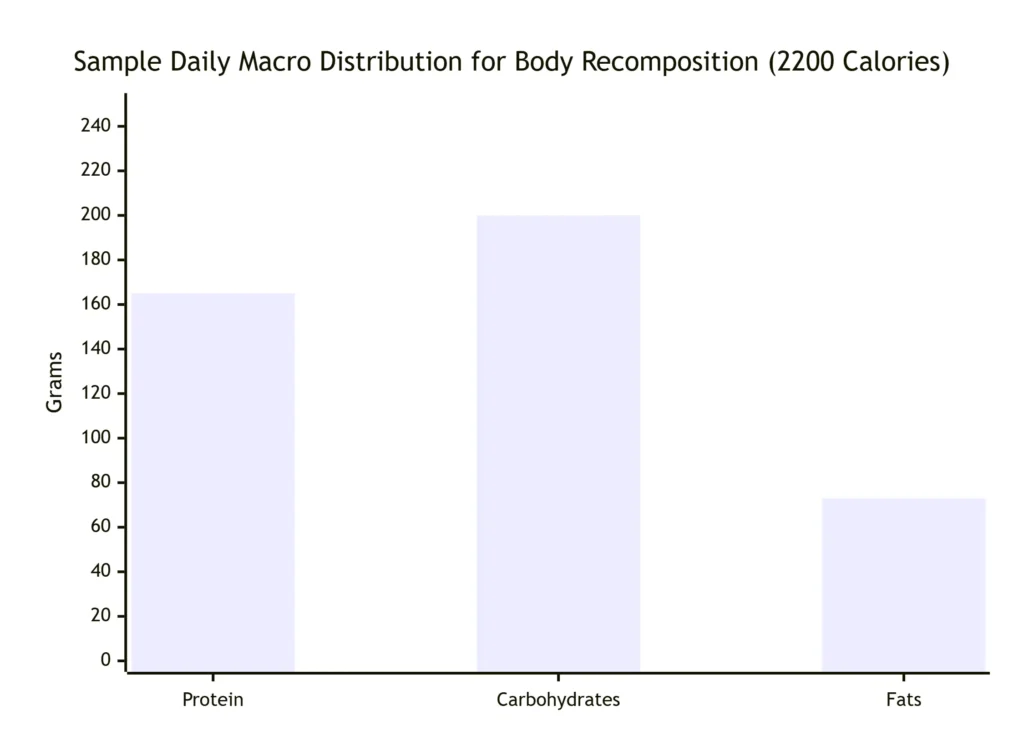
Visualizing Your Path: Macro Distribution for Recomp
The following chart illustrates how your total calorie target is allocated among the three macros during a body recomposition phase, emphasizing the priority of protein.
Frequently Asked Questions
Conclusion
Transforming your physique through muscle gain and fat loss is a science-driven endeavor. It requires moving beyond guesswork and embracing the precision of macronutrient management.
By calculating your TDEE, setting your macro targets with a focus on ample protein, and committing to consistent resistance training, you create the ideal environment for body recomposition.
Remember, progress is measured in photos, strength gains, and tape measurements—not just the scale. Use the calculators and guides provided here as your starting point, stay consistent, and you will unlock the powerful ability to reshape your body.
View Sources
- National Institutes of Health outlines how macronutrients support energy balance and metabolic health, reinforcing why calories still matter regardless of macro distribution. https://www.ncbi.nlm.nih.gov/books/NBK594226/
- Kumar et al., Journal of Applied Physiology demonstrates how resistance training and adequate protein intake stimulate muscle protein synthesis — the foundation of muscle growth. https://journals.physiology.org/doi/full/10.1152/japplphysiol.91355.2008
- International Society of Sports Nutrition (ISSN) supports higher protein ranges for active individuals, particularly during fat loss phases. https://jissn.biomedcentral.com/articles/10.1186/s12970-017-0177-8
- Harvard T.H. Chan School of Public Health emphasizes the role of carbohydrates and fats in supporting training performance and hormonal health. https://www.hsph.harvard.edu/nutritionsource/what-should-you-eat/