
Fat loss gets easier the moment you stop guessing and start budgeting your calories with intention. A calorie deficit diet does not have to feel strict, joyless, or impossible to stick to. In fact, the smartest approach is usually the one that keeps you satisfied enough to avoid late-night snacking while still giving your body a clear reason to use stored fat for fuel. I see this most often with people who try to “be perfect” during the day, then lose control around 9 or 10 p.m. because the deficit was too aggressive to sustain realistically.
This article breaks the process down in plain language, shows you how to estimate your calorie target, and gives you a simple calorie deficit diet plan you can use right away. The goal is simple: eat less than your body burns, but do it in a way that feels realistic, repeatable, and human. That is ultimately how sustainable fat loss works without making the process unnecessarily restrictive.
Also Read: Eat More to Lose Weight: Why Eating Too Little Can Stall Fat Loss
What Is a Calorie Deficit Diet?
A calorie deficit diet is a way of eating where you consume fewer calories than your body needs to maintain its current weight. When that happens, your body has to make up the difference by drawing on stored energy, including body fat.
The National Institute of Diabetes and Digestive and Kidney Diseases (NIDDK) explains that weight loss ultimately depends on creating a consistent energy deficit over time, although food quality and activity levels still affect hunger, adherence, and overall health.
That is the basic reason fat loss works in this approach. It is not magic, and it is not tied to one specific food style. Keto, flexible dieting, macro counting, low-carb plans, and balanced meal plans can all support the same energy-balance principle as long as you stay under your maintenance calories. Those maintenance needs are influenced by your total daily energy expenditure, including movement, exercise, and normal bodily functions.
For example, a keto diet may help some people naturally eat fewer calories because it changes appetite and food choices, but the calorie deficit itself is still the main driver of fat loss.
How Many Calories Should I Eat a Day on a Deficit?
Start with your maintenance calories, then reduce them modestly. For most people, a 10% to 20% reduction is a sensible starting point. Smaller or less active people often do better with the lower end of that range, while larger or more active people may handle a slightly bigger cut.
If you have never tracked before, a macro tracking app can help you see what you really eat on a normal day. Once you know your usual intake, it becomes much easier to reduce it without accidentally going too low. You can also use the deficit calculator to get a faster estimate and avoid doing the math by hand.
A practical approach looks like this: if your maintenance calories are 2,400, a 15% cut brings you to about 2,040 calories per day. If your maintenance is 1,800, a 15% cut brings you to about 1,530 calories per day. The exact number matters less than choosing a target you can consistently follow. Most people do better with a moderate target they can repeat for months than an aggressive target they abandon after two weeks.
The biggest mistake is turning a sensible deficit into an extreme one. Hunger spikes, energy crashes, and cravings usually get worse when the cut is too aggressive. A good deficit should feel challenging, not punishing.
The Calorie Deficit Diet for Fat Loss
To estimate your calorie needs more accurately, many coaches start with basal metabolic rate, or BMR, and then adjust for activity. BMR is the number of calories your body would burn at rest to keep you alive.

A commonly used BMR formula is:
- Men: 66.47 + (6.24 × weight in pounds) + (12.7 × height in inches) − (6.75 × age in years)
- Women: 655.1 + (4.35 × weight in pounds) + (4.7 × height in inches) − (4.7 × age in years)
After you estimate BMR, multiply by an activity factor to estimate maintenance calories. A sedentary person may use about 1.2, lightly active around 1.375, moderately active around 1.55, and very active around 1.725.
Example 1: Man
A 35-year-old man weighs 180 pounds and is 70 inches tall.
BMR = 66.47 + (6.24 × 180) + (12.7 × 70) − (6.75 × 35)
BMR = 66.47 + 1123.2 + 889 − 236.25 = 1842.42 calories
If he is sedentary, estimated maintenance calories = 1842.42 × 1.2 = 2210.90 calories
A 20% deficit would be about 442 calories, so his daily target would be about 1769 calories.
Example 2: Woman
A 30-year-old woman weighs 150 pounds and is 65 inches tall.
BMR = 655.1 + (4.35 × 150) + (4.7 × 65) − (4.7 × 30)
BMR = 655.1 + 652.5 + 305.5 − 141 = 1472.1 calories
If she is sedentary, estimated maintenance calories = 1472.1 × 1.2 = 1766.5 calories
A 20% deficit would be about 353 calories, so her daily target would be about 1413 calories.
That example is useful because it shows why one-size-fits-all advice fails. Two people can both be on a calorie deficit diet and still need very different calorie targets.
The takeaway is simple: your ideal calorie target depends on your body size, activity level, and consistency — not a generic number from social media.
What’s A Good Way to Cut Excess Calories from Your Diet?
The easiest place to start is with liquid calories, because they do not fill you up the way solid food does. Drinks can quietly push you out of a deficit without making you feel any more satisfied.
A simple win is reducing sugary drinks like soda, sweet coffee drinks, energy drinks, and fruit beverages that are mostly sugar. Replace them with water, sparkling water, diet drinks if you use them, or unsweetened tea.
Another easy tactic is to make dinner more filling without making it more calorie-dense. That means more lean protein, vegetables, soups, potatoes, beans, and fruit, while reducing ultra-processed snack foods that are easy to overeat.
You do not need to remove every favorite food. You just need to reduce the foods that give you the least fullness for the most calories. That is how a calorie deficit diet becomes livable instead of miserable.
Exercise And the Calorie Deficit Diet
Exercise helps, but it should not be your only strategy. Burning calories through movement can create extra room in your budget, improve fitness, support muscle retention, and make the diet feel less restrictive. But it is usually much easier to control intake than to burn a huge deficit through workouts alone.
A calories burned calculator can help you estimate how much your workouts contribute. That can be useful if you want to decide whether to eat a little more on training days or keep a steady calorie target every day.
The best combo is simple: keep your food intake within your deficit, lift weights or do resistance exercise to protect muscle, and add walking or cardio for extra calorie burn. Resistance training also helps preserve lean body mass while dieting, especially during longer fat-loss phases. For many people, that combination is far more sustainable than trying to out-exercise a too-low food plan.
Can I Eat Whatever I Want?
Yes, within reason. A calorie deficit diet is about energy balance first. That means the total number of calories matters more than food labels like good or bad.
That said, the quality of those calories matters for hunger, energy, and muscle retention. If you are using macro counting, you can keep favorite foods in the plan while still hitting enough protein, fiber, and healthy fats.
A better question than “Can I eat whatever I want?” is “How much of my calories should come from foods that keep me full?” When protein, produce, and satisfying meals show up consistently, cravings usually get easier to manage. Foods higher in protein and fiber also tend to improve satiety, which can make a calorie deficit easier to maintain over time.
A very workable rule is the 80/20 approach: about 80% of your intake from nutrient-dense foods, and about 20% from foods you enjoy. That balance makes compliance much easier, especially in the evening when boredom and stress often trigger snacking.
How Much of a Calorie Deficit Is Too Much?
For most people, more than a 20% to 25% cut becomes harder to recover from. Hunger rises, workouts suffer, sleep can worsen, and the odds of rebound eating go up.
The warning signs of a deficit that is too aggressive are pretty consistent: constant hunger, low energy, irritability, poor training performance, feeling cold all the time, frequent cravings, and losing weight much faster than planned.
If your plan makes you think about food all day, it is probably too aggressive. The right deficit should reduce your body fat over time without making everyday life feel like a fight.
How Long Does It Take to See Results in a Calorie Deficit?
Some changes show up quickly, but not all of them are fat loss. In the first 1 to 2 weeks, the scale may move because of water, sodium, glycogen, and digestive changes. Real fat loss takes a little longer to notice.
A sensible pace for many adults is about 0.5 to 1 pound per week, although that varies with body size, starting weight, activity level, sleep, and consistency. That slower rate is generally more sustainable than crash dieting approaches. Faster weight loss is harder to maintain and may increase muscle loss and rebound eating risk. Visually, people often notice changes in the mirror or clothes after 3 to 4 weeks of doing the basics well.
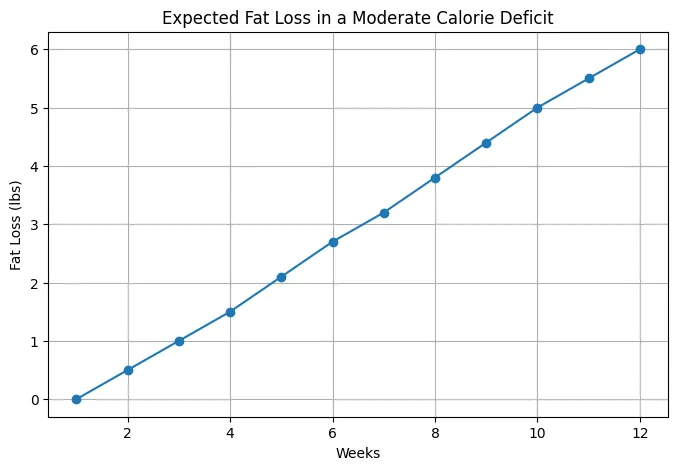
Do not judge progress by one weigh-in. Use the trend across 2 to 4 weeks, plus waist measurements, progress photos, energy, and hunger levels. That gives a much more accurate picture than any single morning on the scale.
What Are the Risks of Cutting Too Many Calories from Your Diet?
Cutting too hard can create a short-term drop on the scale, but it often backfires. The common problems are muscle loss, stronger cravings, low mood, reduced training performance, poor recovery, and trouble sticking to the plan.
Over time, very aggressive dieting can also make people more obsessed with food, which often leads to binge-restrict cycles. That is why a calm, repeatable deficit usually beats a harsh one.
If you feel run down, are losing weight too quickly, or notice dizziness, hair loss, or constipation, your plan may be too aggressive and may need a professional review.
People with diabetes, a history of eating disorders, or medical conditions affecting metabolism should avoid aggressive calorie restriction without professional guidance.
If symptoms persist or your energy drops significantly, it is worth speaking with a qualified healthcare professional rather than continuing to cut calories harder.
Simple Example of a Calorie Deficit Day
Here is a simple plan you can use without fancy supplements or meal services. Adjust the portions to fit your calorie target.
| Meal | What to eat | Why it helps | Approx. calories |
| Breakfast | Eggs or Greek yogurt, fruit, and oats | Protein plus fiber keeps you full | 350-450 |
| Lunch | Chicken, rice or potatoes, and a big salad | Easy to portion and hard to overeat | 450-550 |
| Snack | Cottage cheese, protein shake, or apple with nut butter | Keeps cravings from exploding later | 150-250 |
| Dinner | Lean protein, vegetables, and a measured carb | Satisfying without blowing the budget | 500-650 |
| Planned night snack | A small protein-focused snack if needed | Stops random kitchen raids | 100-200 |
That schedule works because it protects the toughest part of the day. Most people do not fail at breakfast; they fail at night. By planning a small evening snack, you avoid the “I already blew it” mindset and stay in control.
Try this structure for a week:
- Set your calorie target using maintenance calories minus 10% to 20%.
- Hit a protein goal at every meal.
- Keep one planned evening snack inside your calories.
- Walk daily and strength train several times per week.
- Review your weekly weight trend and adjust only if progress stalls for 2 to 3 weeks.